
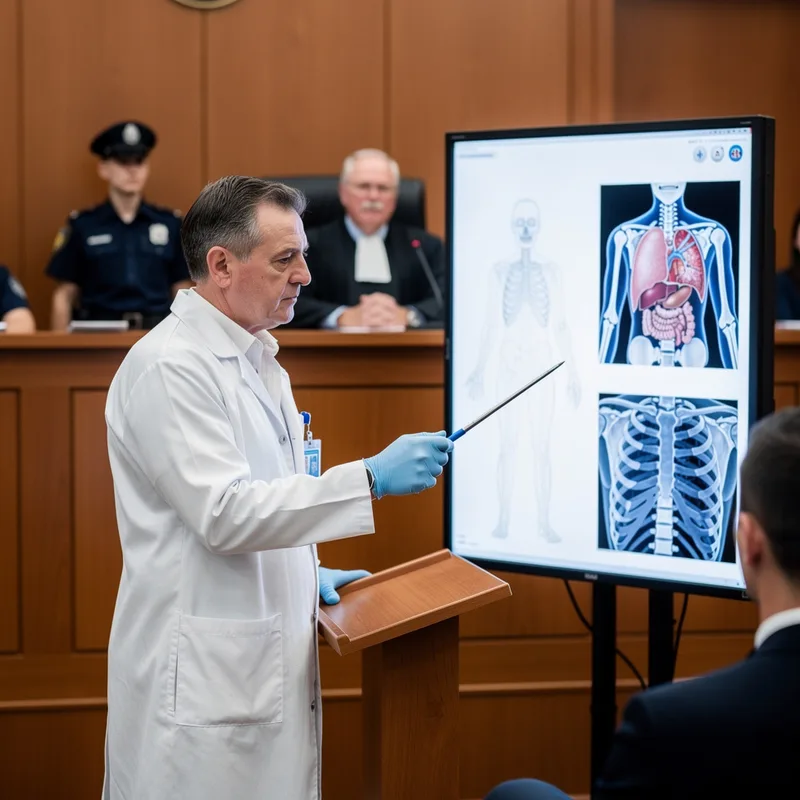
forensic medicine
 1
3.7
1
3.7

- noun
- /fɔːˈrɛn.sɪk ˈmɛd.ɪ.sɪn/
- Specialized
- The Tenth Edition (1902) contains an unmemorable two-page article, essentially a shortened version of the article in the previous edition, by H. H. Littlejohn, a professor of forensic medicine at the University of Edinburgh.
Examples
-
I am a professor of forensic medicine.
-
Forensic medicine is an interdisciplinary science that, in everyday practice, applies all the knowledge that medical sciences have accepted as reliable and scientifically solid facts or processes, and qualitative and quantitative definitions, with the help of which accurate and reliable statements can be made.
Academic text (2007) -
" So when did forensic medicine begin here in Europe? "
Fiction book (2002) -
You hold a position in forensic medicine at Humboldt University, in addition to your work here?
Fiction book (2002) -
Back then, this place, which was Germany's first institute of forensic medicine, was a completely up-to-date modern facility.
Fiction book (2002) -
It was vitally necessary to understand forensic medicine in order to mount a credible defense for a client.
Fiction book (1990) -
Forensic odontology has emerged as one of the most important offshoots of forensic medicine.
Academic text (2007) -
The ultimate aim of using anthropometry in forensic medicine/science is to help law enforcement agencies achieve 'personal identity' in the case of unknown human remains.
Academic text (2007) -
Whether or not Jared Loughner is mentally or emotionally unstable will be decided by the courts (forensic medicine).
Blog text (6) -
The role of forensic medicine is essential in solving criminal cases.
How Legal

Surface Forms
Morphology
The meaning is directly and predictably derived from combining 'forensic' (relating to legal/court investigation) with 'medicine' (the medical field): it denotes the medical subfield applied to legal questions. This adjective + noun composition is a standard, cross-linguistically common pattern, so a B1 learner who knows both constituents would readily infer the MWE meaning.
Etymology
Forensic medicine comes from a Latin word: forensic meant 'of the public court' and medicine meant doctors' knowledge. In ancient Rome, doctors went to the public forum to help judges and give medical evidence. That's why today forensic medicine means using medical knowledge to answer legal questions.