
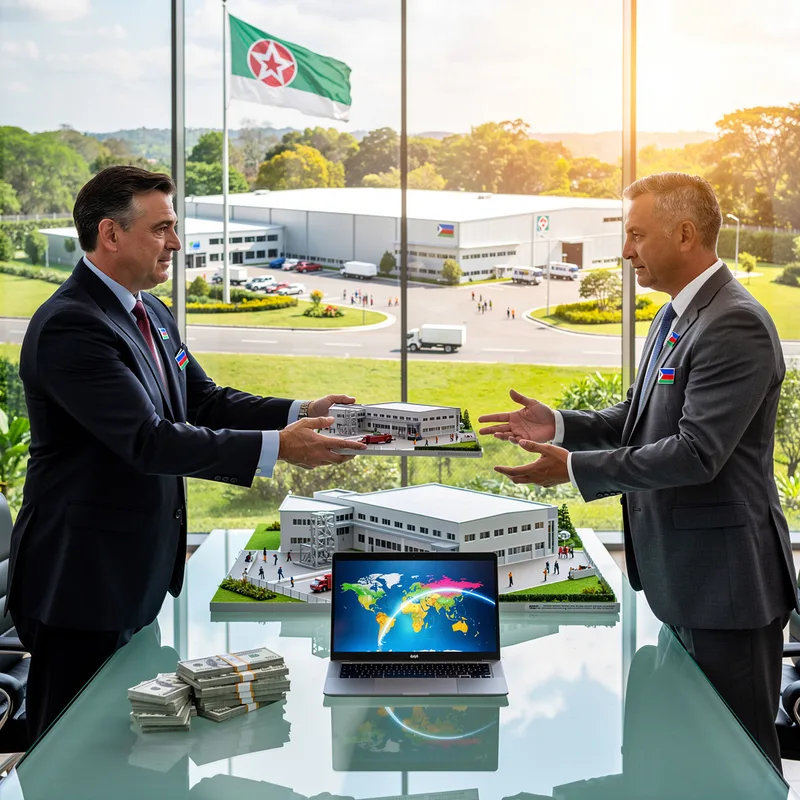
foreign direct investment
 2
4.6
2
4.6

- noun
- /ˈfɔrɪn daɪˈrɛkt ɪnˈvɛstmənt/
- Specialized
- The "global triad," which includes North America, Europe, and East and Southeast Asia, now dominates foreign direct investment (FDI).
- foreign direct investment flows
- attract foreign direct investment
- amount of foreign direct investment
Examples
-
As a result, by 1991, Latin America enjoyed up to 15 times more foreign direct investment than the Middle East.
Academic text (1995) -
Despite government efforts to attract foreign capital, foreign direct investment (FDI) has fallen precipitously over the past four years.
Academic text (2016) -
Meanwhile, only 30 percent report being involved in foreign direct investment opportunities.
Blog text (29) -
UN figures showing foreign direct investment in the UK up last year.
-
Only 15 percent of it is funded by foreign direct investment.
Academic text (2012) -
Canada and Mexico have not sent very much foreign direct investment into the United States (Table 12).
Academic text (1997) -
IU report: Indiana has been a top destination for foreign direct investment.
Blog text (33) -
In several of the smaller and poorer nations, they far exceed external aid and net foreign direct investment.
Blog text (12) -
The relaxation of restrictions on foreign direct investment will not guarantee massive inflows.
Academic text (1997) -
The government is implementing new policies to encourage foreign direct investment in renewable energy projects.
Surface Forms
Morphology
foreign + direct + investment
The overall meaning — an investment from one country into business interests in another done without intermediaries — is directly derivable from the parts: 'foreign' (from another country) + 'direct' (straight/no one between) + 'investment' (committing money expecting benefit). The construction is compositional, relatively literal, and has clear cross‑linguistic equivalents (e.g. Spanish/French cognates), so a B1 learner who knows the constituents can grasp the term.
Etymology
Foreign direct investment shows a clear picture: foreign means from another country, direct means you control it yourself, and investment means putting money into a business. So when a company builds or buys a factory abroad to 'own' and 'run' it, that action is called 'foreign direct investment' because the money is used to take direct ownership or control in another country.