
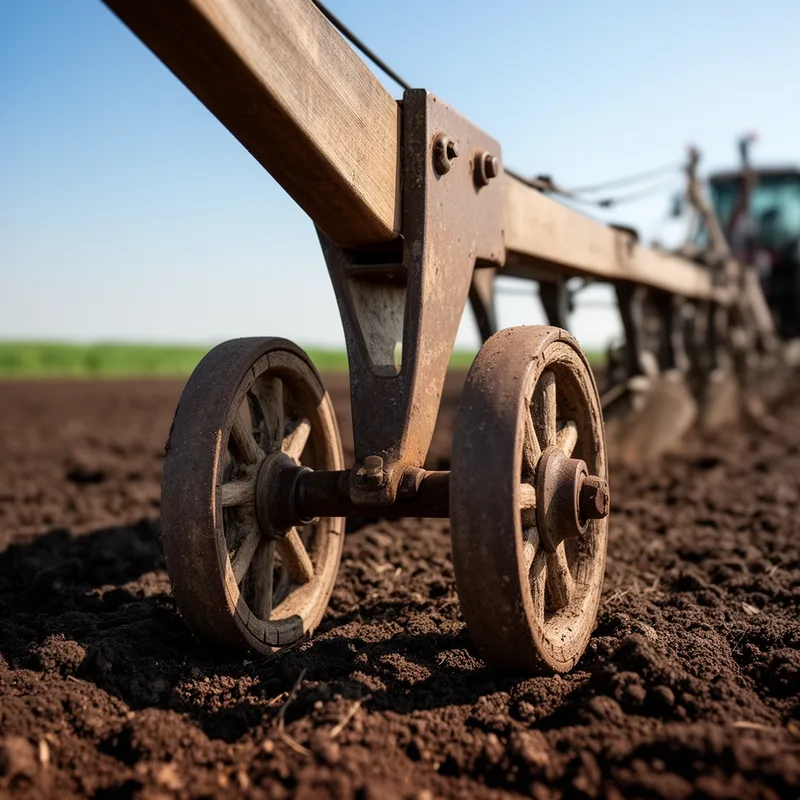
fore carriage
- noun
- Specialized
- The farmer repaired the fore carriage to ensure the plow moved smoothly across the field.
Examples
-
Older plows often required a sturdy fore carriage for better stability and ease of use.
-
After years of use, the wooden wheels on the fore carriage needed to be replaced.
-
The farmer repaired the fore carriage of his plow.
-
Many fore carriages are made from durable materials.
-
After years of use, the wooden wheels on the fore carriage needed to be replaced.
-
Older plows often required a sturdy fore carriage for better stability and ease of use.
-
The farmer repaired the fore carriage to ensure the plow moved smoothly across the field.
Synonyms
A small support with wheels under the front of a plow that holds and guides it
A small set of wheels under the front of a plow that holds and guides it
Surface Forms
Morphology
fore + carriage
The compound is directly compositional: 'fore' conveys 'front' or 'at the front' and 'carriage' denotes a wheeled support, so a B1 learner who knows both constituents can infer a carriage at the front of the plow. The meaning follows a straightforward English locative/compound pattern (front + carriage) common across languages, making the MWE immediately understandable from its parts.
Etymology
The noun fore carriage comes from a simple image: fore means 'front' and carriage is like a small 'cart' placed under the plow beam. So the picture of a little wheeled cart holding the front explains why it 'supports' and 'guides' the plow as it moves across the field.

