
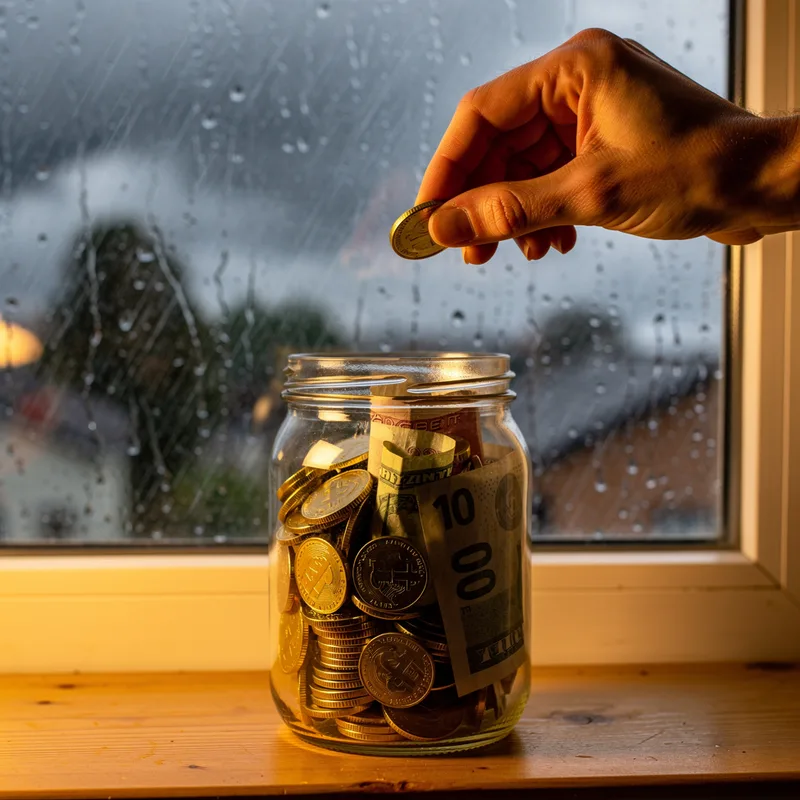
for a rainy day
 15
3.4
15
3.4

- idiom
- Informal
- Save them for a rainy day.
- save for a rainy day
- savings for a rainy day
- put away for a rainy day
Loading YouTube…
Watch on YouTubeIt just stores fat away, you know, for a rainy day, but then there's no rainy day.
- It just stores fat away, you know, for a rainy day, but then there's no rainy day.
- People decide how much cash to keep kind of for a rainy day.
- And the point of having a toolbox is not just to put it in the closet for a rainy day.
Examples
-
Very few people are saving for a rainy day anymore.
Blog text (24) -
I've been saving this for a rainy day!
-
Ten grand for a rainy day.
-
Put the money you save in an emergency fund for a rainy day.
Blog text (14) -
I elected to put that money into a bank account and save it for a rainy day.
Blog text (22) -
It's common knowledge that you should save money for a rainy day.
Blog text (8) -
At least six months' worth of expenses is a good goal for a rainy day fund.
Blog text (21) -
Even if you can only spare a few dollars a week, make saving for a rainy day a priority.
Blog text (2) -
Why don't you save that for a rainy day?
-
It's wise to keep some money saved for a rainy day, just in case an emergency arises.
Synonyms
 256
3.3
256
3.3
To be ready for something that might happen
Antonyms

How Soon
106
3.4
 23
3.0
23
3.0
- Informal
15
3.4
4
3.3
Surface Forms
Morphology
The phrase uses a conventional metaphor (a "rainy day" = a time of trouble) so its purpose of saving for future difficulty is not literally spelled out by the individual words but is inferable from the image. A B1 learner who knows 'for', 'rainy', and 'day' may guess it refers to setting something aside for a future bad time, but this requires cultural/metaphorical knowledge rather than straightforward compositional meaning.
Etymology
For a rainy day comes from a simple picture: people saved food or money when the sun was out so they would have it on a rainy day. So today it means 'kept or saved for use in the future, especially in an emergency'.