

fool's cap
- noun
- Archaic
- During the school play, the character dressed as a jester wore a traditional fool's cap with bells.
Examples
-
The teacher made the student wear a fool's cap as a silly punishment for not paying attention in class.
-
In the station, they are drawn by the clash of a tambourine to a crowd that has gathered around a performer, a clown of sorts, only half in costume, with a fool's cap on his head and a frothy pink collar pinned to his t-shirt.
Fiction book (1996) -
Riding at his side was a dwarf mounted on a pony, wearing a particolored tunic and a fool's cap.
Fiction book (2001) -
In medieval times, a fool's cap symbolized a person's role in entertaining the court, often highlighting their foolish behavior.
Synonyms

 2
2.8
2
2.8

A hat worn for fun, often at parties
 1
9.2
1
9.2
A pointed paper hat teachers put on a student as punishment in old classrooms
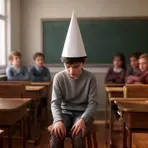
A pointed paper hat put on students' heads to shame them
Antonyms




Surface Forms
Morphology
fool's + cap
The combination 'fool's' + 'cap' transparently signals a cap belonging to or associated with a fool, so a B1 learner who knows the constituents can infer it is a hat used to mark someone as foolish or for ridicule. However, the precise historical form (a cone-shaped paper/dunce cap) and punitive usage are culturally specific and not fully predictable from the words alone, so it is only partially transparent.
Etymology
Fool's cap comes from an old classroom practice where teachers put a tall, cone-shaped paper cap on a slow or lazy student's head to show they were a 'fool'. That's why fool's cap came to mean the hat itself or any object that marks someone as foolish.