
fluoroscopic


 1
7.9
- adjective
- /ˌflʊəroʊˈskɒpɪk/
- Specialized
- Studies have shown that the information gleaned from fluoroscopic and endoscopic examinations with respect to laryngeal penetration and aspiration is similar.
- fluoroscopic guidance
Examples
-
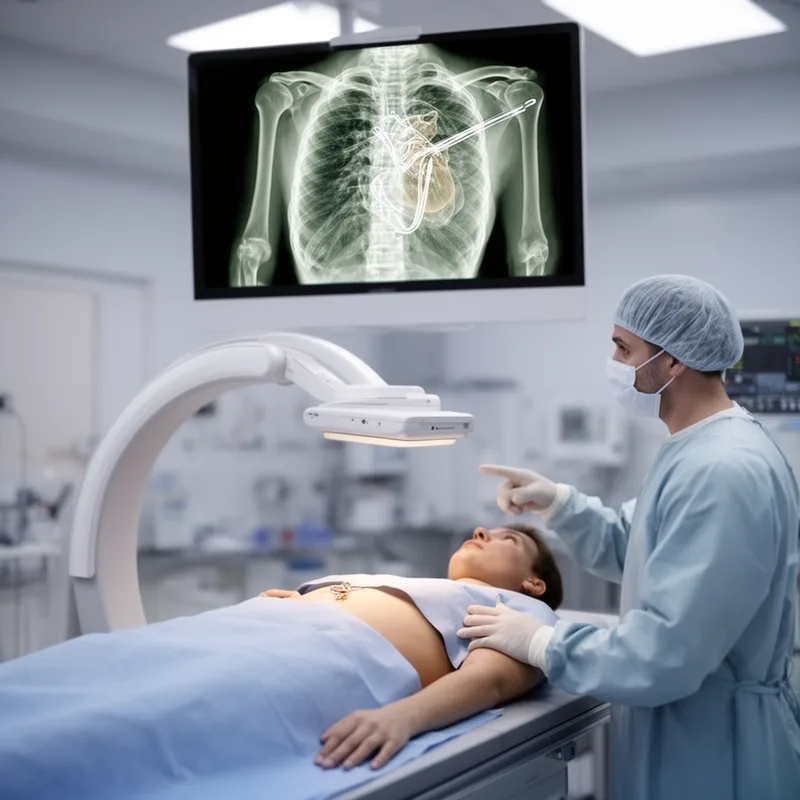
The fluoroscopic technique allows doctors to view moving structures inside the body while performing surgery.
-
Three days later, a nasojejunal tube was placed under fluoroscopic guidance without difficulty.
Academic text (2008) -
The nail is placed down into the IM space with fluoroscopic guidance (C-arm x-ray).
Academic text (2007) -
Nearly all pediatric femoral neck fractures are now treated in the operating room under general anesthesia and fluoroscopic guidance.
Academic text (2006) -
Sclerosing injection was performed with 95% ethanol via the indwelling catheter under fluoroscopic monitoring.
Academic text (1998) -
Figure 2. Vascular territories in the rat brain. Fluoroscopic imaging techniques were used to quantify vessel density and distribution in coronal sections of rat brains.
Academic text (2004) -
The radiopaque stent and two markers on the delivery catheter allow fluoroscopic control of stent release and positioning across the stricture.
Academic text (1992) -
The surgeon used the fluoroscopic monitor to guide the procedure in real time.
-
During the examination, the fluoroscopic images revealed the movement of the patient’s internal organs.
Surface Forms
Morphology
fluoroscopic = fluoroscopy (transparent) = fluoroscopy + ic
Formed by the regular adjective suffix '-ic' from the noun 'fluoroscopy', so the relation is a direct adjectival derivation.
Etymology
Fluoroscopic comes from fluoro-, the part meaning 'glow' as in fluorescent, and -scopic, which means 'to look' as in microscope. So, fluoroscopic describes using a glowing screen that doctors 'look' at to watch moving parts inside the body live.