

flowering ash
- noun
- The landscaping featured a stunning flowering ash that attracted many bees and butterflies.
Examples
-
They they would slash the bark of flowering ash trees around the Mediterranean and this stuff would ooze out and which they called mana.
-
In spring, the flowering ash fills the garden with its fragrant white blooms.
-
During our picnic, we enjoyed the shade provided by a grand flowering ash tree with beautiful flowers.
Synonyms
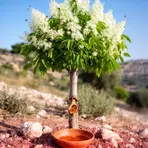
A small ash tree from the southern Mediterranean that has sweet-smelling white flowers and produces a sap called manna

A southern Mediterranean tree with white fragrant flowers and a sweet sap used as a sweetener

A small, bushy ash tree from the southwestern United States that has fragrant white flowers

A small ash shrub from California with attractive pale white flowers
Surface Forms
Morphology
The phrase 'flowering ash' is a straightforward modifier+noun combination where 'flowering' (bearing blossoms) describes the kind of 'ash' (a Fraxinus tree), so the meaning 'an ash tree that is in flower or bears showy flowers' is directly derivable from its parts. This compositional pattern is standard in English and cross-linguistically common, so a B1 learner who knows both words will readily understand the MWE.
Etymology
The noun flowering ash names an ash tree that is covered in many white flowers in spring. That picture explains the name and why people grow the tree for its beauty and to attract bees.

