

flourish
 2
7.3
2
7.3

- noun
- /ˈflʊrɪʃ/
 :
fanfarria
:
fanfarria
- "The single drummer rolled a flourish, and the fifer started the tune.
Examples
-
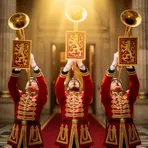
The music suddenly becomes a flourish of trumpets.
Fiction book (1997) -
The new royal family, the Council, Polonius and his son, and Lords Attendant enter to a flourish of trumpets.
Academic text (2002) -
With a final flourish, the music ceased.
Fiction book (2002) -
The history play ended with a flourish of all the dancers jumping and whirling together, and all the musical instruments playing.
Fiction book (1994) -
With a flourish, Ms. Wolff played her final chord.
Fiction book (2002) -
The rest of the party carried on into the marquee, where the couples on the floor were just finishing up a round of "Strip the Willow." The music concluded with a flourish, attended by breathless laughter and applause from the dancers.
Fiction book (1991) -
The program closed with a flourish of the orchestra, the credits rolled, and the sponsor's message—Brought to you by Her Holy Church—flashed across 100 million TV screens.
Fiction book (2002) -
With a grand flourish, the conductor introduced the symphony before the audience.
-
The ceremony started with a dramatic flourish of trumpets announcing the arrival of the dignitaries.
-
As the speech concluded, he made a sweeping flourish with his hand to emphasize his final point.
Synonyms
 12
5.3
12
5.3
A short lively tune trumpets play to introduce someone important

A short bright tune played on trumpets to announce something
Idioms

How Ceremonial

Surface Forms
Etymology
The word flourish comes from the Latin root florere, which means 'to bloom', and is the same root as flower. A musical flourish is a bright, showy 'bloom' of sound used to announce something, so fanfares and short brass passages are called flourishes.