

to flatten out
 5
3.4
5
3.4

- phrasal verb
- /ˈflætən aʊt/
- The aerial photographs show... that this... this gully runs back here about half a mile... then flattens out into a meadow.
Loading YouTube…
Watch on YouTubeMaybe it's sort of flattens out as you get to a certain speed.
- Maybe it's sort of flattens out as you get to a certain speed.
- Yes, yes, the curve flattens out, which is diminishing sensitive.
- All of this becomes kind of flattened out, no longer as effective.
- So a binder is a compression garment, super tight and just flattens out, flattens out the chest.
- Your tricep is here and then it flattens out some.
- So flatten out that image here, as you can see, or stretch it back.
- But when my when, when, when the sort of ramp of my learning starts to flatten out a bit, I tend to get bored of those games.
Examples
-
The colors of the room swam together, then flattened out.
Fiction book (1996) -
After rolling the dough, make sure to flatten out any air bubbles before baking.
-
You can see how it's starting to flatten out across the body.
-
But now it's starting to flatten out at the top.
-
"Look up ahead, I think it flattens out," he called back.
Academic text (2002) -
So they want to flatten out the distribution.
-
The land flattened out before them, and the jungle stretched away.
Fiction book (1992) -
The hills have flattened out to endless swells, with crests of sedimentary rock through which the highway is carved.
Fiction book (2002) -
She used a roller to flatten out the wrinkles in the fabric.
-
The technician needed to flatten out the surface before applying any paint.
Synonyms
 81
3.7
81
3.7
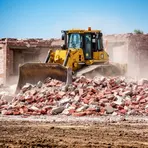
To make land or a building flat with the ground
 39
1.3
39
1.3
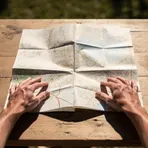
Open something that is folded so it becomes flat
 23
2.6
23
2.6
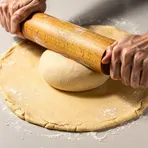
Make something flat and smooth by pressing it
 22
2.5
22
2.5
To make something level or smooth
 18
3.4
18
3.4
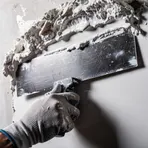
To make a surface, amount, or relationship level by removing differences
 11
2.9
11
2.9
To make something free of bends, twists, or knots
 8
3.4
8
3.4
To make something flat by unrolling it or using a roller
 3
5.3
3
5.3
To make the edges of a pile of papers level and straight
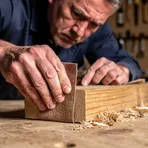 2
6.1
2
6.1
Wear a surface away slowly by rubbing, or make someone very tired
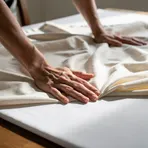 1
3.8
1
3.8
To make something less rough by pressing it flat or by calming people
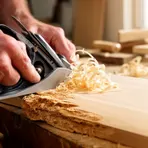 1
7.5
1
7.5
To make a surface smooth by shaving thin layers of wood

To make the ground flat for building or planting
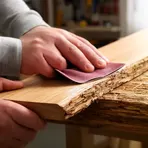
To make a surface flat and even by rubbing or polishing

To make paper or cloth smooth again after it becomes wrinkled

Smooth a wrinkled area of skin, fabric, or lips

Make a surface flat using a heavy roller machine
How Flat

Surface Forms
Morphology
The core meaning comes directly from 'flatten' (make flat) while the particle 'out' adds a sense of spreading, finishing, or making uniformly flat; together they yield 'make or become flat/smooth', which a B1 learner who knows both constituents can readily infer. This verb+particle composition is a common, predictable pattern in English (and has parallels in other languages), so the expression is compositional and transparent.
Etymology
Flatten out comes from the image of pressing something so the bumps disappear and it spreads out to lie flat. So it now means 'to become or make smooth or level' and, by extension, 'to stop changing quickly', as with paper, hills, or prices.