
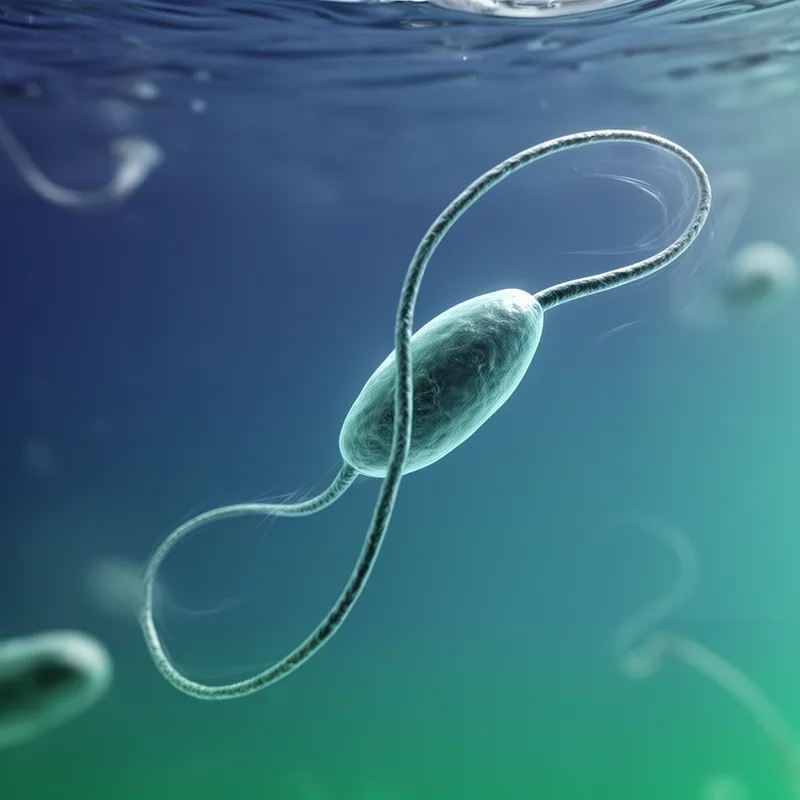
flagellum
 1
9.9
1
9.9

- noun
- /fləˈdʒɛləm/
- Specialized
- That's the indication of a new study in the journal Human Reproduction that found men with wider variation in sperm length, particularly in the flagellum, had lower concentrations of sperm that could swim well.
- bacterial flagellum
Loading YouTube…
Watch on YouTubeSo that's that's too flagella in a in a basket, just just moving along.
- So that's that's too flagella in a in a basket, just just moving along.
Examples
-
In the bottom illustration, a bacterium propels itself by waving its flagellum up and down in an undulatory motion.
Academic text (2002) -
Bdellovibrio bacteriovorus uses a single polar flagellum to stalk other bacteria.
Academic text (2017) -
It has a single polar flagellum, but it also forms biofilms.
-
The degree of curvature depends on the frequency with which the flagellum is waved up and down.
Academic text (2002) -
Variations in sperm length, particularly in the tail (flagellum), indicate a lower concentration of sperm that swim well.
Blog text (27) -
A new study published online in the journal Human Reproduction finds that the greater the inconsistency in the length of sperm, particularly in the tail (flagellum), the lower the concentration of sperm that can swim well.
Blog text (32) -
Because the flagellum is flexible, it acquires a curvature whose concavity depends on the direction of its motion—concave down while the flagellum is moving upward, concave up when moving downward.
Academic text (2002) -
The sperm cell uses a flagellum to swim toward the egg for fertilization.
-
In many protozoa, the flagellum acts like a propeller to help them move through water.
-
The bacterium moves efficiently by rotating its flagellum in a whip-like motion.
Compounds

Surface Forms
Etymology
Flagellum comes from Latin flagellum meaning 'little whip', and biologists chose this word because the long tail on some cells looks and moves like a whip. So a biological flagellum is a whip-like part that helps a cell swim.