
filibuster
 34
8.8
34
8.8

- noun
- /ˈfɪlɪˌbʌstər/
- Senator Joe Lieberman: "For too long, we have accepted the premise that the filibuster rule is immune."
- filibusters of judicial nominations
- judicial filibusters
- filibusters to defeat legislation
Loading YouTube…
Watch on YouTubeOK, so let's talk about the filibuster.
- OK, so let's talk about the filibuster.
- And to some degree, imagine what happens if there is no filibuster.
Examples
-
So there could be no delays, there could be no filibusters and no amendments filling the legislation with new earmarks, loopholes and special interest provisions.
-
Under the new rule, sixty votes are needed to terminate a filibuster, rather than a majority of those present.
Academic text (1992) -
Senators in the era of divided government increasingly use the filibuster as a matter of course.
Academic text (2003) -
In particular, I wrote against talking filibusters yesterday, and then again today.
Blog text (10) -
Among the most noteworthy victims of the filibuster was early civil rights legislation.
Academic text (2004) -
The bill met defeat after a lengthy filibuster that generated much ill will on both sides of the conflict.
Academic text (1990) -
And Harry Reid promised the Senate would reform the filibuster for the next session.
Blog text (7) -
Indeed, the public perceives the filibuster as an act of principled public courage and sacrifice.
Blog text (4) -
Absent reconciliation, a 60-vote supermajority is needed to stop a filibuster and advance a bill.
Blog text (13) -
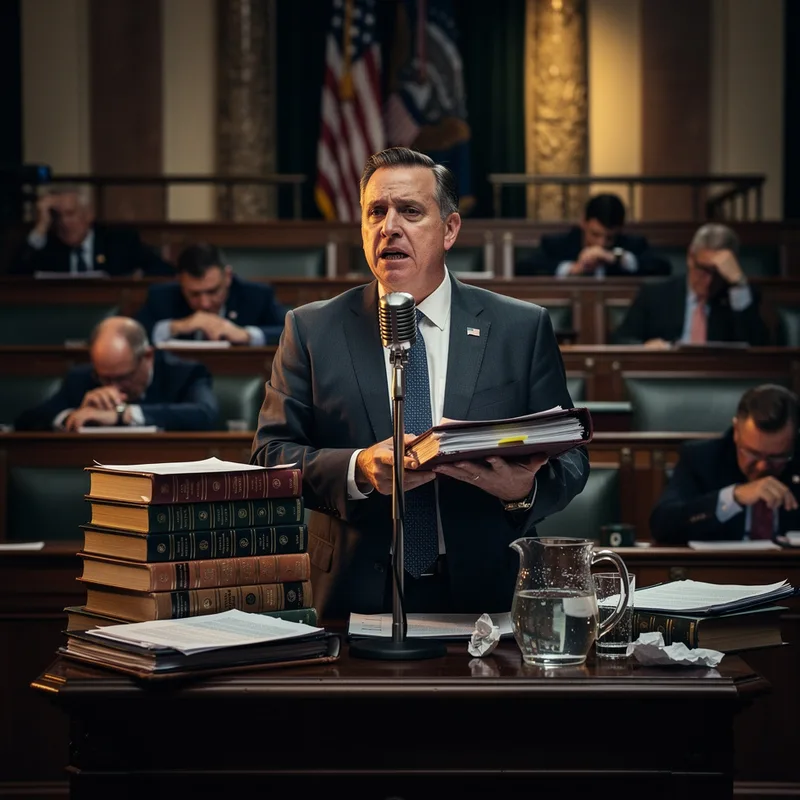
The senator delivered an extensive speech in an attempt to prevent the vote, engaging in a classic filibuster.
Synonyms
 222
4.8
222
4.8
Something that stops or slows progress and makes a task hard
 11
6.2
11
6.2
A deliberate delay used to gain more time
 10
8.6
10
8.6
A way of slowing a process on purpose to stop change, often in politics
 7
6.3
7
6.3
Delaying something on purpose to gain time or avoid a decision
Antonyms

How Obstructive

Surface Forms
Etymology
Filibuster comes from Spanish filibustero, meaning 'pirate', and the image stuck because the tactic 'steals' time in a meeting. So a filibuster is a very long speech (or set of speeches) used to delay or stop a vote.