
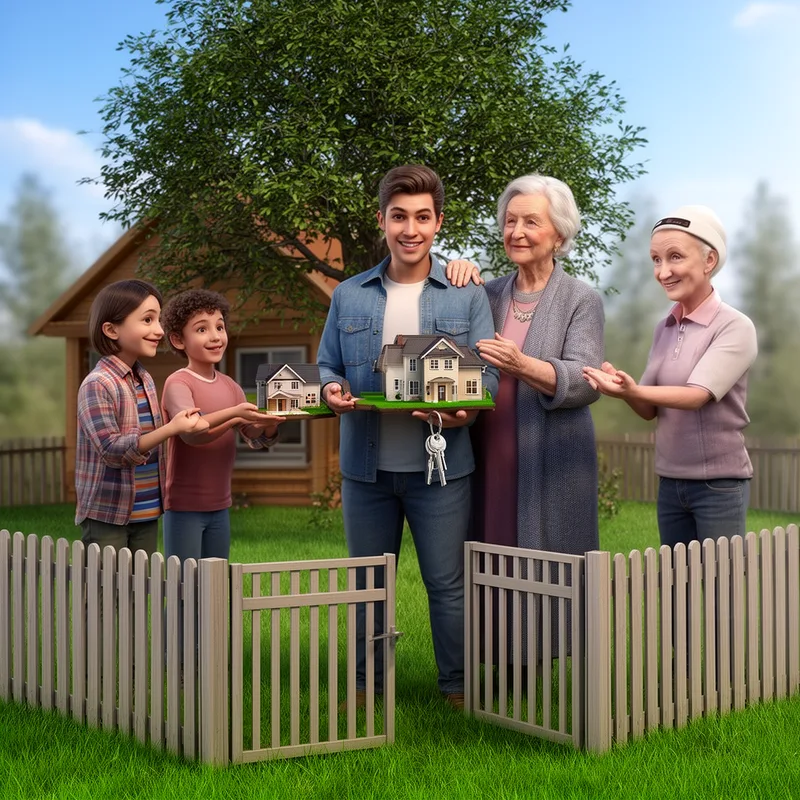
fee simple


 1
9.8
1
9.8
- noun
- /fiː ˈsɪmpl/
- Formal
- He was thrilled to acquire his family home in fee simple, ensuring it could be passed down to his children.
- fee simple absolute
- fee simple title
- land in fee simple
Examples
-
In the United States, if one owns property in fee simple absolute, it means one owns the land from the surface of the soil down to the center of the planet.
Academic text (1993) -
Each house is owned in fee simple, just like a traditional house in just about any town anywhere in America.
Blog text (13) -
In contrast, he wanted fee simple title to his farm.
Academic text (2018) -
As of May 2007, record fee simple title to the property was held by Sweeney-Bronze Development, LLC ("SBD").
Blog text (23) -
The principle of fee simple absolute is derived from medieval law, and it flourished in Anglo-Saxon Britain.
Academic text (1993) -
After such time, all trust restrictions would be lifted, and the landowner would be granted all the legal rights adhering to fee simple property ownership, including the right of alienation.
Academic text (2018) -
Each house is owned in fee simple, providing the owner complete rights to sell or bequeath the property.
-
In the United States, owning land in fee simple gives you absolute ownership and control over the property.
Synonyms
 33
9.3
33
9.3
A right to land that can be passed to your children

Full ownership of a house or land that you can sell and leave to someone
Surface Forms
Morphology
The parts 'fee' (an inheritable estate) and 'simple' (meaning 'without further qualification') do suggest an estate without limitations, so a learner who knows those senses could approximate the meaning. However, the expression is a specialized legal term with an archaic/postpositive use of 'simple' and a precise technical sense that is not fully predictable without legal knowledge or exposure.
Etymology
Fee simple comes from an old land system where a fee meant a piece of land given by a lord and simple meant 'no special rules'. So holding land in fee simple meant you truly 'own' it and can 'sell' it or 'leave' it to anyone.