

farce
 64
5.3
64
5.3

- noun
- /fɑrs/
- The play was a hilarious farce that had the audience laughing from start to finish.
- elements of farce
- call a farce
- French farce
Loading YouTube…
Watch on YouTubeIt was all a farce and the court saw right through it.
- It was all a farce and the court saw right through it.
- The trial was a farce of Freudian proportions.
- It's, in my opinion, a huge farce.
- History repeats itself, first as a tragedy, second as a farce.
- But in my opinion, this whole industry recovery initiative is a farce.
- The the thing about the movie is that, as you say, they take they took my trauma, our trauma, all of the trauma and made it like a farce.
- It should have been if the actors start winking at the camera, it it it just strays into farce.
- And after looking at these two hundred groups, I could only conclude that the majority of them were spending money to keep this whole farce alive.
- Others will call it a farce or or pathological or a historical failure.
- That's like the whole Tony Stark like vision of the entrepreneur is a farce.
Examples
-
I don't know what the purpose of this farce was, but it is really annoying.
Blog text (10) -
The idea of putting Craig in charge was a farce from the beginning.
Fiction book (1999) -
I told you then it was all a farce.
-
But do not turn this hearing into a farce.
-
Justice Griffin, this trial has been a farce!
-
It was all a farce and the court saw right through it.
-
I served as director, if not yet producer, for many of these farces.
Fiction book (2000) -
As in a French farce, Kenny walked in the front door, and the dog slid out the back.
Fiction book (1998) -
Enough of this farce.
-
The trials of vigilantes and other perpetrators of mob violence were mostly a farce.
Academic text (2003)
Synonyms
 350
1.0
350
1.0
A funny event or series of events that makes people laugh
 2
8.7
2
8.7
A play or story that makes fun of something by exaggerating its style

A comedy with silly impossible situations and loud physical jokes
Antonyms

Compounds
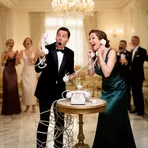
A light, silly comedy set among rich people that often includes white telephones as a sign of luxury
How Absurd


Surface Forms
Etymology
Farce comes from the old French verb farcir, which means 'to stuff'. Long ago, small funny scenes were 'stuffed' into serious plays, so farce came to mean a very silly comedy of exaggerated mistakes and fast action.