
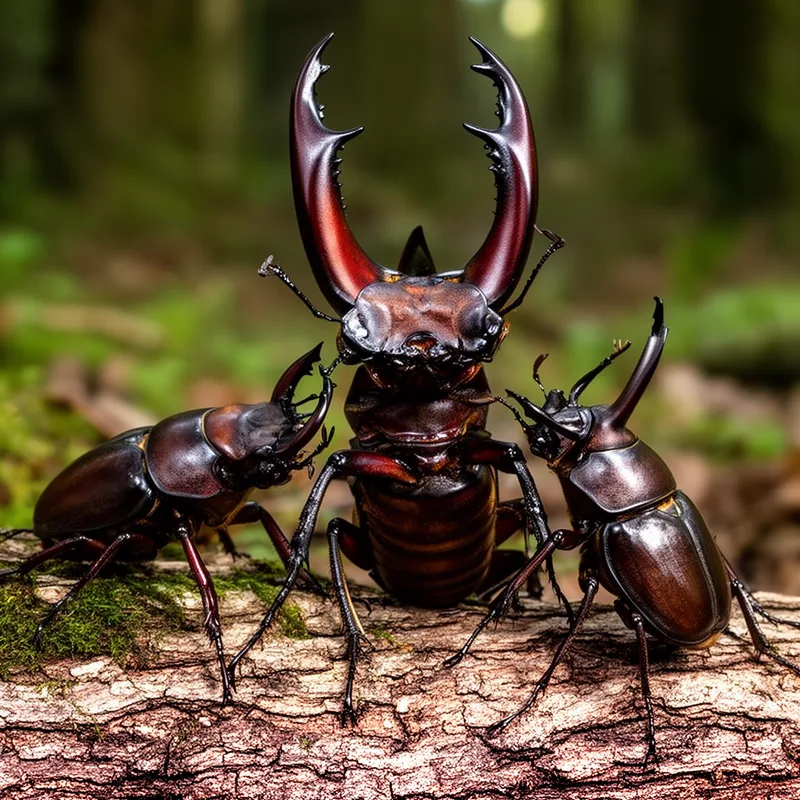
family Lucanidae
- noun
- /ˈfæmɪli luˈkeɪnɪdi/
- Specialized
- Many species in the family Lucanidae exhibit remarkable sexual dimorphism, with males often having much larger mandibles than females.
Examples
-
The family Lucanidae includes some of the largest beetles in the world.
-
Many members of the family Lucanidae are prized by insect collectors for their striking appearance.
-
Entomologists often study family Lucanidae to understand the evolution of beetle mandibles.
-
The family Lucanidae includes many fascinating species.
-
Did you know that the family Lucanidae has over 1,200 species?
-
Research shows that the family Lucanidae plays a significant role in its ecosystem as decomposers and pollinators.
-
In gardens, beetles from the family Lucanidae can sometimes be seen contributing to the biodiversity in the area.
Synonyms

A group of large beetles with strong bodies and big jaws, often called stag beetles
Surface Forms
Morphology
This is a straightforward taxonomic noun phrase: 'family' (a scientific grouping) combined with the proper name 'Lucanidae' denotes that beetle family. The composition follows normal naming conventions used across languages, so a B1 learner who knows both constituents will readily understand the meaning.
Etymology
Family Lucanidae comes from the older scientific name Lucanus, which originally meant 'from Lucania', a region in Italy. So family Lucanidae simply names the group of beetles related to Lucanus, the stag beetles known for their big jaws.

