

family Ixodidae
- noun
- /ˈfæmɪli aɪˈkoʊdəˌdeɪ/
- Specialized
- Scientists studied several species from the family Ixodidae to understand tick-borne diseases.
Examples
-
Veterinarians must be aware of the family Ixodidae when treating pets for tick infestations.
-
The family Ixodidae is responsible for transmitting Lyme disease to humans.
-
The family Ixodidae includes many species of ticks.
-
Many animals are affected by the family Ixodidae of ticks.
-
The family Ixodidae consists of ticks that can transmit diseases to both animals and humans.
-
Researchers are focusing on the family Ixodidae to develop better prevention methods for tick bites.
-
An understanding of the family Ixodidae is crucial for controlling tick populations in wildlife.
Synonyms
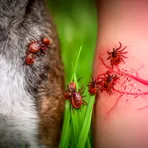
A group of hard ticks that can spread disease to animals and people

A tick with a hard shield on its back and a mouth that sticks out from its head

A tick with a hard shield on its back and mouth parts that stick out from its head
Surface Forms
Morphology
This is a straightforward compositional taxonomic phrase: 'family' (a scientific grouping) combined with the taxon name 'Ixodidae' yields 'the family named Ixodidae' or 'a family of hard-bodied ticks.' If a learner knows both constituents, the overall meaning is directly derivable and follows common cross-linguistic taxonomic naming patterns.
Etymology
Family Ixodidae comes from the genus name Ixodes, a Greek word for 'tick', plus the ending -idae, which marks a 'family' or group of animals. So the name paints the picture of a group of hard, biting ticks and is used today for that whole group of species.

