
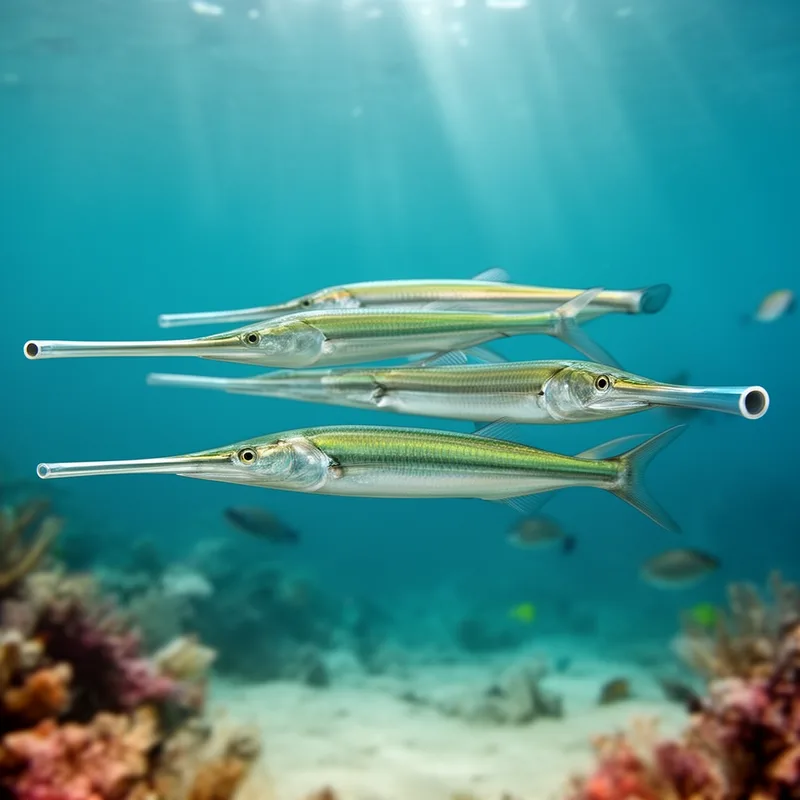
family Fistulariidae
- noun
- /ˈfæmɪli ˌfɪstjʊˈlɛrɪˌeɪ/
- Specialized
- Distinctive for their long bodies and tubular snouts, the family Fistulariidae is fascinating to marine biologists.
Examples
-
Members of the family Fistulariidae can be found in tropical and subtropical oceans worldwide.
-
The family Fistulariidae consists of only a few species, all commonly known as cornetfishes.
-
The family Fistulariidae includes several unique species.
-
Did you know that the family Fistulariidae is known for its tubular snouts?
-
The family Fistulariidae includes various species of cornetfishes often seen in coral reefs.
-
Researchers are studying the family Fistulariidae due to their unique adaptations to marine environments.
-
Among elongated fishes, the family Fistulariidae is particularly recognized for its distinctive shape.
Synonyms
A group of long thin sea fish like cornetfish found in warm seas
Surface Forms
Morphology
The phrase is compositionally transparent: 'family' denotes a taxonomic grouping and 'Fistulariidae' is the name of that group, so the label plainly refers to the taxonomic family of cornetfishes. This scientific naming pattern is cross-linguistically common and follows standard noun + name composition, so a B1 learner who knows both constituents would understand the meaning.
Etymology
The name family Fistulariidae comes from the old Latin word fistula, meaning 'pipe', because these fish have long, tube-like snouts. So the name points to their pipe-shaped mouths and helps explain why this family is the group of cornetfishes.

