
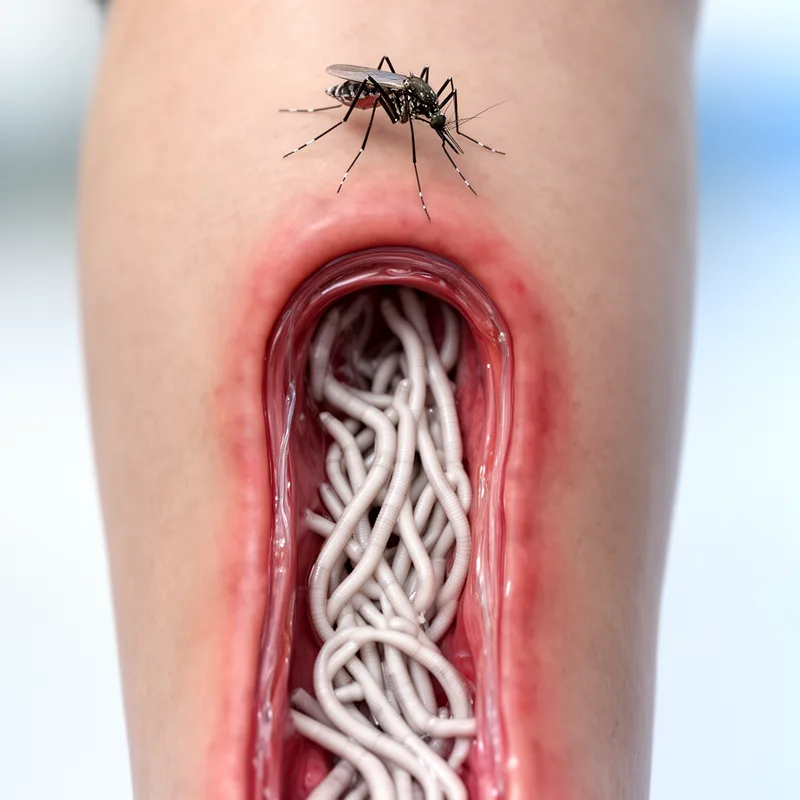
family Filariidae
- noun
- /ˈfɪləˌrɪəˌdeɪ/
- Specialized
- The family Filariidae includes several species known to cause dangerous diseases in humans.
Examples
-
Members of the family Filariidae are transmitted to hosts by various types of insects.
-
Scientists discovered a new species within the family Filariidae during their expedition.
-
The family Filariidae includes several species that can infect humans.
-
Many members of the family Filariidae are known to cause serious diseases.
-
The family Filariidae includes several species known to cause dangerous diseases in humans.
-
Members of the family Filariidae are transmitted to hosts by various types of insects.
-
Many members of the family Filariidae are known to cause serious diseases.
Synonyms

Slender threadlike worms that live in people and animals and cause disease
Surface Forms
Morphology
This is compositionally transparent: 'family' (a scientific grouping) combined with the taxonomic name 'Filariidae' directly denotes the biological family of those parasitic roundworms. Although 'Filariidae' is technical, if a learner knows that constituent, the overall meaning is immediately derivable from the parts and follows common cross-linguistic taxonomic patterns.
Etymology
Family Filariidae comes from the part filari-, which means 'thread', because these worms are long and thin like threads. That's why the name is used for this group of small parasitic worms that can infect people and other animals.

