
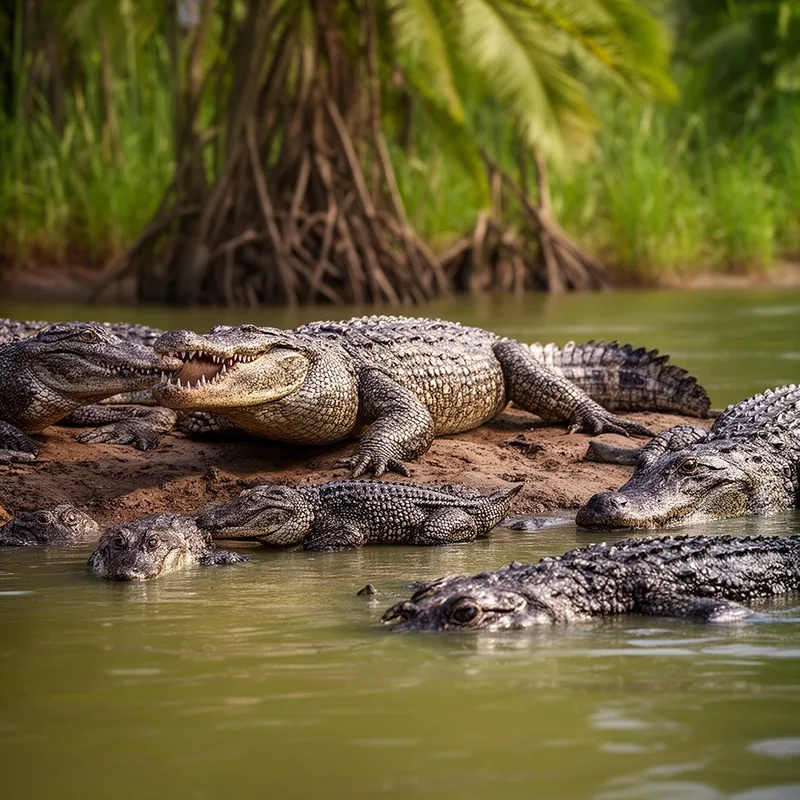
family Crocodylidae
- noun
- /ˈfæmɪli krɒkəˈdaɪliː/
- Specialized
- The family Crocodylidae contains several species of large, powerful reptiles found in Africa, Asia, the Americas, and Australia.
Examples
-
The family Crocodylidae includes species like the Nile crocodile.
-
Scientists study evolutionary differences between the family Crocodylidae and its close relatives such as alligators and gharials.
-
Most members of the family Crocodylidae are formidable predators adapted for life in rivers and swamps.
-
Many members of the family Crocodylidae are known for their powerful jaws.
-
Most members of the family Crocodylidae are formidable predators adapted for life in rivers and swamps.
-
The family Crocodylidae contains several species of large, powerful reptiles found in Africa, Asia, the Americas, and Australia.
-
Scientists study evolutionary differences between the family Crocodylidae and its close relatives such as alligators and gharials.
Synonyms

 94
1.0

A large reptile with a long snout, strong jaws, and sharp teeth that lives in rivers and lakes
A group of large meat-eating reptiles that live in warm places, for example the Nile crocodile and the saltwater crocodile
Surface Forms
Morphology
The phrase combines the general noun 'family' (a taxonomic grouping) with the taxon name 'Crocodylidae' (true crocodiles), so a learner who knows both constituents can directly infer it means the family of crocodiles. Taxonomic noun phrases follow a regular, cross-linguistic composition pattern in scientific register, making the meaning transparent to learners familiar with the component words.
Etymology
Family Crocodylidae may come from old Greek words meaning pebble and worm, because people long ago thought a crocodile looked like a long worm covered in stones. That's why the name now refers to the group of 'crocodile' species.