
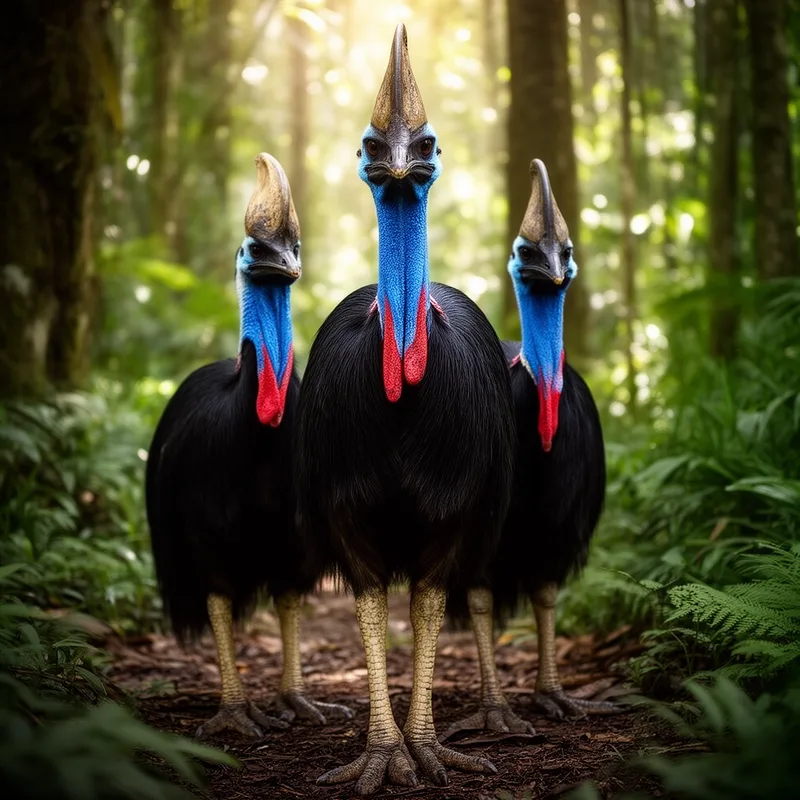
family Casuaridae
- noun
- /ˈfæmɪli ˌkæzjʊˈɛrɪdeɪ/
- Specialized
- The family Casuaridae includes three species of cassowaries found in Australia and New Guinea.
Examples
-
The family Casuaridae includes some of the largest flightless birds.
-
Scientists study the evolutionary history of the family Casuaridae to understand flightlessness in birds.
-
Members of the family Casuaridae are known for their distinctive helmet-like casques.
-
Did you know the family Casuaridae consists of cassowaries?
-
The family Casuaridae is famous for its large size and flightless nature, characterized by unique features like their helmet-like casques.
-
Researchers are exploring the family Casuaridae to gain insights into the evolution of flightlessness among birds.
-
Among the birds in the family Casuaridae, cassowaries are particularly notable for their striking appearance and powerful legs.
Synonyms
A family of large birds that cannot fly, like cassowaries and emus
Surface Forms
Morphology
The phrase is fully compositional: 'family' denotes a taxonomic grouping and 'Casuaridae' is the name of that taxon, so the meaning—the taxonomic family Casuaridae of large flightless birds—is directly derivable from the constituents. Taxonomic naming patterns are cross-linguistically regular, so a B1 learner who knows both words will understand this expression.
Etymology
Family Casuaridae comes from the bird name cassowary plus the family ending -idae, which is added to show a group of similar animals. So, family Casuaridae simply means the 'family' or group of cassowary birds.

