
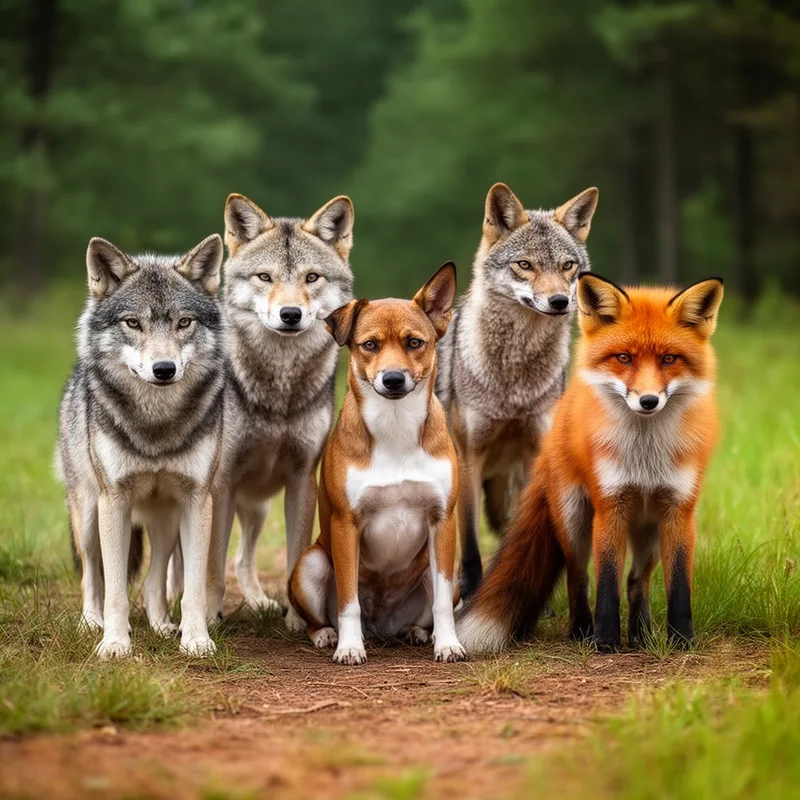
family Canidae


 1
5.2
- noun
- /ˈfæmɪli ˈkeɪnɪdeɪ/
- Specialized
- Biologists study the evolutionary history of the family Canidae to understand canine diversity.
Examples
-
The family Canidae includes both wild and domestic species such as wolves and dogs.
-
Foxes are a member of the family Canidae, sharing many traits with dogs.
-
The family Canidae includes many species of wild and domestic animals.
-
Did you know that the family Canidae has over 30 species?
-
The family Canidae includes various species such as dogs, wolves, and foxes, all known for their keen hunting skills.
-
In the wild, members of the family Canidae often hunt in packs to capture their prey.
-
Researchers study the family Canidae to understand their social behaviors and communication methods.
Synonyms
 1
9.9
A family of meat-eating mammals like dogs, wolves, and foxes
Surface Forms
Morphology
The phrase 'family Canidae' is directly compositional: 'family' (a taxonomic group) combined with the proper taxon name 'Canidae' yields the meaning 'the taxonomic family Canidae, which includes dogs, wolves, foxes, etc.' Taxonomic constructions of this sort are cross-linguistically regular and thus immediately comprehensible to a B1 learner who knows both constituent words.
Etymology
Family Canidae comes from the Latin word canis, which means 'dog'. It is the name scientists use for the group of dog-like animals such as wolves, foxes, jackals and domestic dogs, so the name shows they belong to the same 'dog' family.