

family Bradypodidae
- noun
- /ˈfæmɪli brædɪˈpɒdɪdi/
- Specialized
- Members of the family Bradypodidae are easily recognized by their slow movements and long, curved claws.
Examples
-
The family Bradypodidae consists of several genera of tree-dwelling sloths found in Central and South America.
-
Scientists have studied the evolutionary adaptations of the family Bradypodidae in relation to their arboreal lifestyle.
-
The family Bradypodidae includes several species of sloths.
-
Did you know that the family Bradypodidae is native to South America?
-
The family Bradypodidae is known for its unique adaptations to a slow-moving life in the trees.
-
Within the family Bradypodidae, sloths are distinguished by their distinctive, long limbs that help them navigate their habitat.
-
Researchers are focusing on the family Bradypodidae to understand the ecological roles of sloths in rainforest environments.
Synonyms
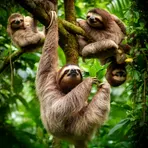
A family of slow mammals that live in trees in Central and South America, including three-toed sloths
Surface Forms
Morphology
The phrase is fully compositional: 'family' signals a taxonomic grouping and 'Bradypodidae' is the scientific name of that group, so a learner who knows both constituents will understand it refers to the taxonomic family called Bradypodidae (the sloths). Taxonomic naming conventions are cross-linguistically common and follow a predictable pattern, making the meaning transparent to learners.
Etymology
Family Bradypodidae comes from Greek words: the part brady- means 'slow' and the part -pod means 'foot'. That image of 'slow' feet is why the name is used for the family of sloths, animals that move very slowly.

