

false truffle
- noun
- /fɔls ˈtrʌfəl/
- The false truffle can be mistaken for genuine truffles due to its similar appearance.
Examples
-
The false truffle can be mistaken for genuine truffles due to its similar appearance.
-
Some foragers avoid collecting false truffles because they are inedible or mildly toxic.
-
Researchers studied the false truffle to understand its effect on local wildlife.
-
A false truffle can often be mistaken for its edible counterpart.
-
The false truffles found in the forest are not edible.
-
Some foragers avoid collecting false truffles because they are inedible or mildly toxic.
-
Researchers studied the false truffle to understand its effect on local wildlife.
Synonyms

 4
7.9
4
7.9

A round mushroom that releases a cloud of spores when mature

A poisonous fungus with a hard outer skin that looks like a truffle

A small mushroom with a hard outer skin that grows underground like a truffle
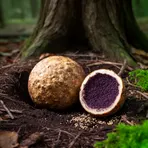
A round fungus with a hard skin that usually grows under the ground

A fungus that grows underground like a truffle near tree roots

A fungus that makes truffle-like underground fruiting bodies and lives with pine roots
Surface Forms
Morphology
The meaning is directly compositional: 'false' (not genuine/imitation) combined with 'truffle' (the edible fungus) yields an item that resembles a truffle but is not a true one. The 'false + noun' pattern is common cross-linguistically, so a B1 learner who knows both constituents can readily infer this meaning.
Etymology
False truffle may have its name from the simple image of a fungus that pretends to be a truffle: it looks like a truffle but is false. So the name reminds people that it looks similar but is 'not a real truffle'.