
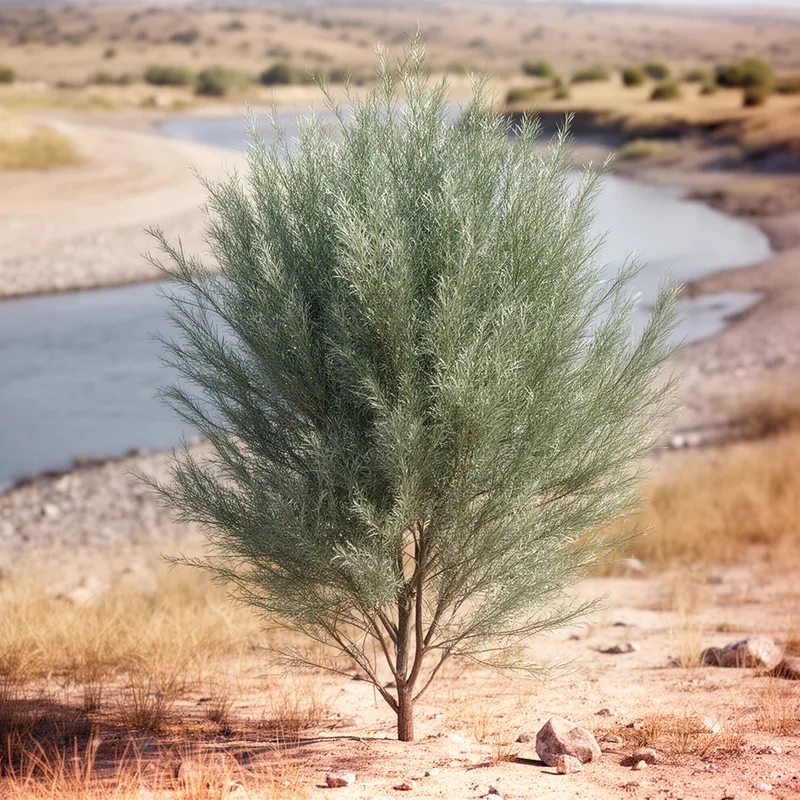
false tamarisk
- noun
- Gardeners often plant false tamarisk for its feathery foliage and resilience.
Examples
-
The false tamarisk thrives in sandy soils along riverbanks in its native Eurasia.
-
Many gardeners choose false tamarisks for their drought-resistant properties.
-
Although called false tamarisk, this shrub belongs to a different genus than true tamarisks.
-
The false tamarisk thrives in arid climates.
-
Many gardeners choose to plant false tamarisk because it grows well in dry climates.
-
The false tamarisk is often found in sandy areas, providing a beautiful backdrop in gardens.
-
This hardy shrub, known as false tamarisk, is commonly used in landscaping for its ability to withstand drought.
Synonyms
A bush with thin branches and many small leaves that often has pink flowers and grows near rivers or coasts

A small bush with narrow leaves and pink flowers that grows on sandy riverbanks in Europe and Asia
Surface Forms
Morphology
The phrase directly combines 'false' (an imitation or not genuine) with the plant name 'tamarisk', so the meaning 'a shrub that resembles but is not a true tamarisk' is compositionally inferable. The adjective+noun pattern 'false X' is common in botanical and general usage and is cross-linguistically familiar, making it understandable to a B1 learner who knows both constituents.
Etymology
False tamarisk gets its name from a simple image: plant experts put false before tamarisk to show the shrub 'looks like' a tamarisk but is a different kind. So the name reminds you it is a tamarisk-like shrub that is 'not a true tamarisk'.

