
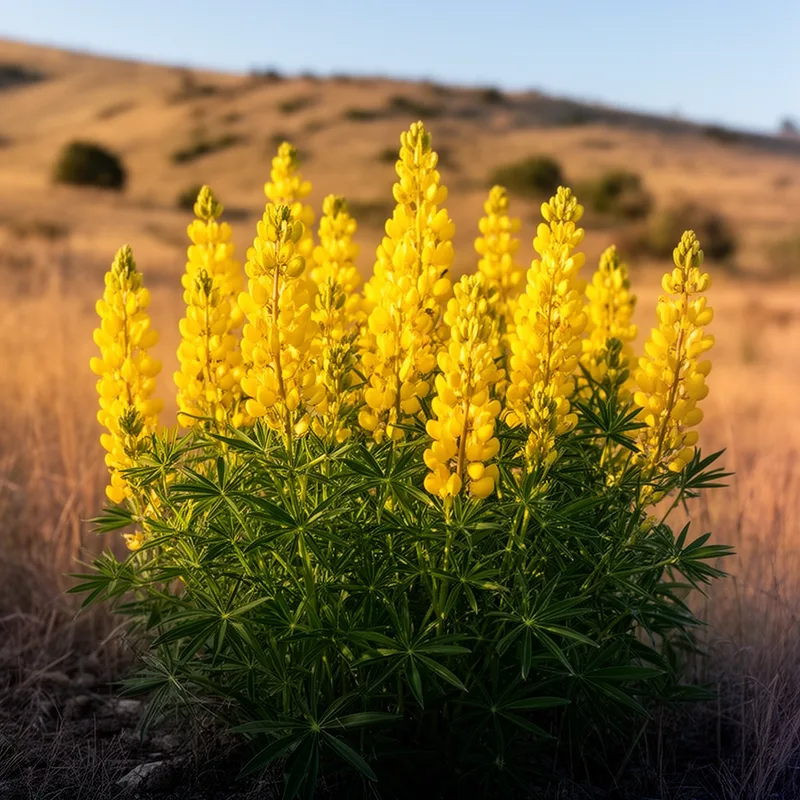
false lupine
- noun
- /fɔls ˈluːpaɪn/
- Specialized
- Gardeners sometimes mistake false lupine for true lupine due to their similar appearance.
Examples
-
The false lupine brightens the hills each spring with its yellow blossoms.
-
Can you identify the false lupine among the wildflowers?
-
During our hike, we spotted several clusters of false lupine near the trail.
-
The false lupine blooms beautifully in spring.
-
During our hike, we spotted several clusters of false lupine near the trail.
-
Gardeners sometimes mistake false lupine for true lupine due to their similar appearance.
-
The false lupine brightens the hills each spring with its yellow blossoms.
Synonyms

A bushy flowering plant with large leaves and bright yellow, pea-like flowers in the western United States

A bushy plant with small yellow flowers that grows in the western United States

A bushy plant with bright yellow, pea-shaped flowers from western United States
Surface Forms
Morphology
The noun phrase is directly compositional: 'false' signals an imitation or non-genuine instance and 'lupine' names the plant, so a speaker who knows both words can infer it is a plant resembling a true lupine but not the genuine species. This NAME-pattern (e.g., 'false indigo', 'false hellebore') is common cross-linguistically, making the meaning immediately derivable for learners.
Etymology
False lupine is named for how it looks. Its yellow, pea-like flowers and bushy shape remind people of a real lupine, but it is a different plant, so they called it false to show 'not a true lupine'.

