

false face
 1
7.2
1
7.2

- noun
- For Halloween, he decided to create a spooky false face to impress his friends.
Examples
-
It was performed by "an Indian disguised with a hideous false face, having horns on his head."
Academic text (1992) -
I'm not gonna have anybody put a false face on me.
-
Ten or twelve young men privately put on false faces, the most frightful they can invent.
Academic text (1992) -
During the masquerade, she wore a beautiful false face to conceal her identity.
-
The performers adorned themselves with elaborate false faces to enhance their costumes at the festival.
Synonyms
 659
1.0
659
1.0
A covering worn on the face to hide, protect, or decorate it
 40
3.9
40
3.9
An outward appearance that hides someone's real identity or intentions
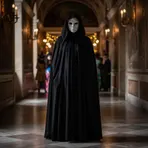 8
9.9
8
9.9
A loose cloak and mask worn at a masquerade to hide your identity
 1
8.4
1
8.4
A decorative mask worn at a party or on stage to hide the face
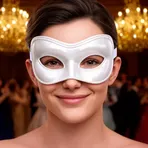

 1
4.0
1
4.0
A mask that covers the upper part of the face, leaves the mouth visible, and has holes for the eyes

A mask that covers the face, often worn at fancy parties
Surface Forms
Morphology
The meaning 'a mask worn to disguise the face' is directly derivable from combining 'false' (an imitation or deceptive) with 'face' (the front part of the head), so the phrase effectively denotes an imitation or fake face. This compositional pattern (false + noun = imitation of that noun) is common in English and across languages, so a B1 learner who knows both words would readily infer the MWE's meaning.
Etymology
The noun false face comes from the simple image of someone putting on a false face like a mask at a party or in a play. That's why false face means 'a mask worn to disguise the face'.