
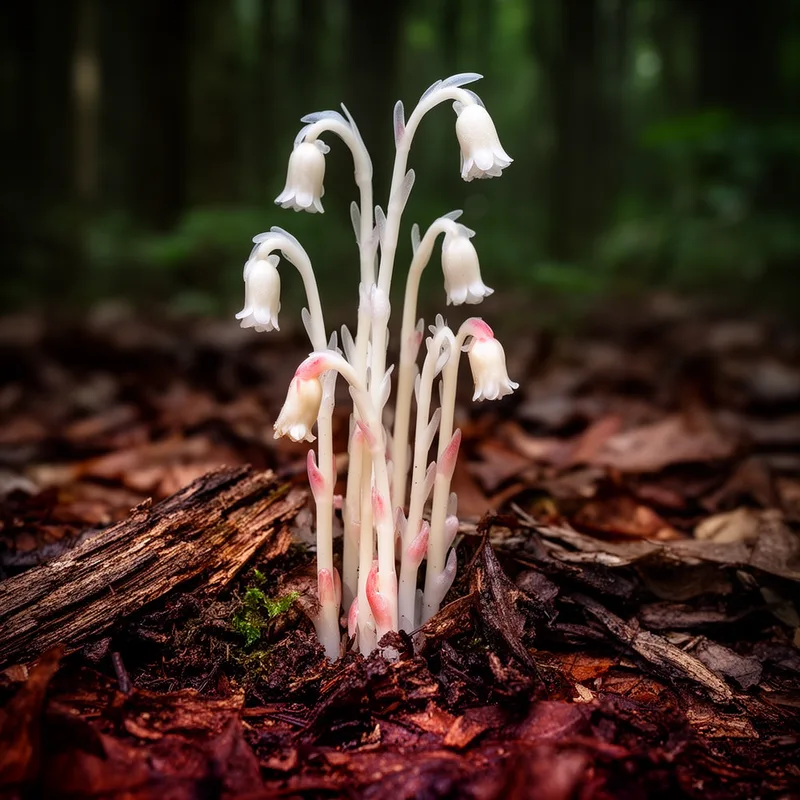
false beachdrops
- noun
- US
- We spotted a cluster of false beachdrops growing among the leaf litter in the forest.
Examples
-
Because false beachdrops lack chlorophyll, they rely on decaying matter for their nutrients.
-
The botanist explained how false beachdrops differ from the closely related Indian pipe.
-
The false beachdrops thrive in the shaded forest floor.
-
Have you seen the false beachdrops near the old oak tree?
-
We spotted a cluster of false beachdrops growing among the leaf litter in the forest.
-
The botanist explained how false beachdrops differ from the closely related Indian pipe.
-
Because false beachdrops lack chlorophyll, they rely on decaying matter for their nutrients.
Synonyms

A fleshy reddish plant that does not make food from sunlight and grows in shaded woods on decaying leaves

A small reddish forest plant that does not make food from the sun and gets food from dead leaves
Surface Forms
Morphology
false + beachdrops
The structure 'false' + [noun] is a regular, compositional pattern meaning an imitation or lookalike; if a learner knows the noun 'beachdrops' as a plant, they can infer that 'false beachdrops' is a plant resembling or mimicking beachdrops. This semantic relation is straightforward and cross-linguistically common, so a B1 learner who knows both constituents would readily understand the meaning.
Etymology
False beachdrops get their name from how the plant looks: small, drooping brownish beachdrops that lie like 'drops' on the forest floor. The word false shows they only look like the true beachdrops and do not have green leaves but feed on dead leaves.

