
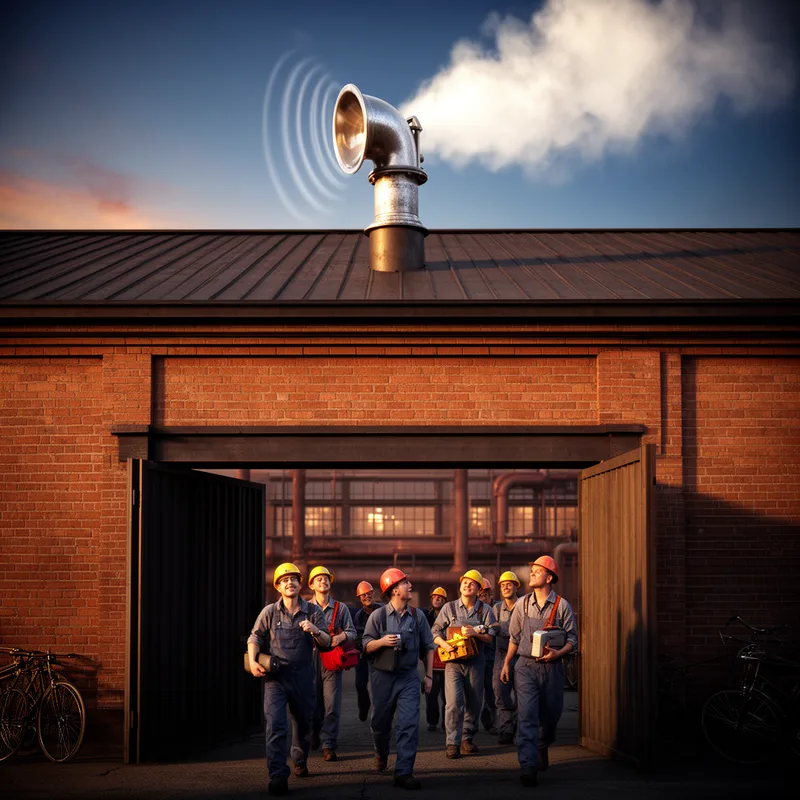
factory whistle


 1
3.9
1
3.9
- noun
- (FACTORY WHISTLE)
Examples
-
Everywhere, factory whistles and sirens hooted jubilantly.
Fiction book (1992) -
(FACTORY WHISTLE)
-
Whale's tongue trips on the word, his voice suddenly drowned out by the blast of a factory whistle.
Fiction book (1998) -
A quarter past four, Brad starts up again, his yells as regular as a late-night train or factory whistle.
Fiction book (1991) -
Industrialization would eventually bring the factory whistle, the steamship, the locomotive, and, by the nineteenth century, the telegraph and the telephone, creating a more scheduled world.
Academic text (2004) -
The factory whistle carried low, just above ground level, howling every morning on a single note capable of expressing only the immensity of the darkness that flowed down the ravine of Factory Street through all the hours of day and night.
Fiction book (2000) -
(FACTORY WHISTLE)
-
(FACTORY WHISTLE)
-
(FACTORY WHISTLE)
-
At precisely 5 PM, the factory whistle signaled the end of the workday, and the workers rushed outside.
Synonyms
 56
1.0
56
1.0
A high loud sound made by a person, a device, or fast moving air
 1
4.6
1
4.6
A loud horn on steam engines used to signal or warn
Surface Forms
Morphology
The meaning is directly and transparently composed from 'factory' (a place of production) + 'whistle' (a device that makes a sharp tone): it refers to the whistle used at a factory to signal work times. This simple noun–noun/possessive composition is common cross-linguistically and follows basic English compounding, so a B1 learner who knows both constituents will readily infer the meaning.
Etymology
Factory whistle comes from the loud whistle blown at a factory so workers across the town could hear when it was time to 'start' or 'stop' work. So today it means a whistle that signals the beginning or end of a work period.