
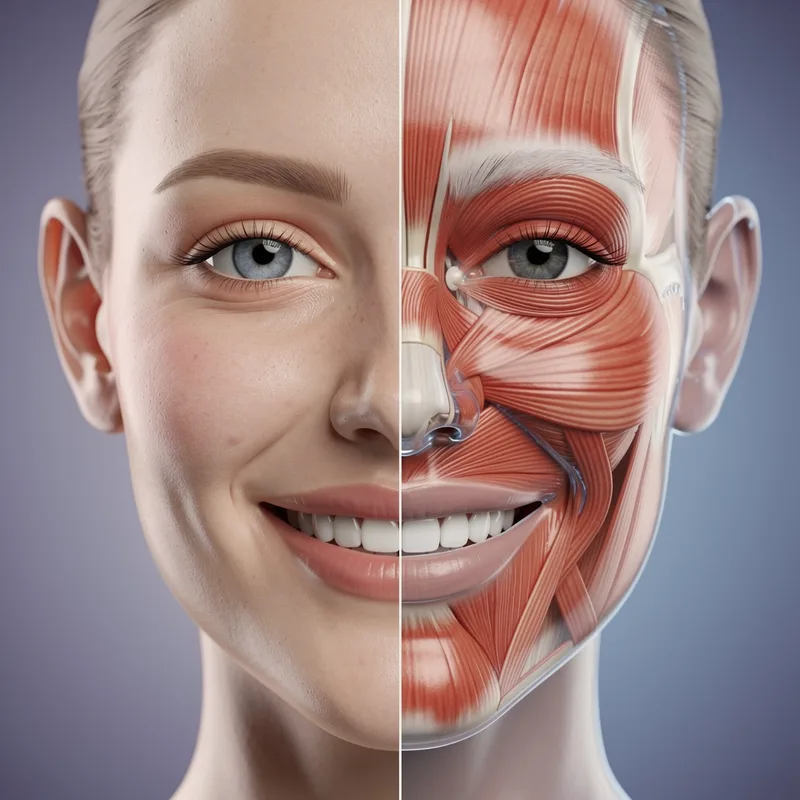
facial muscle
 3
3.3
3
3.3

- noun
- /ˈfeɪʃəl ˈmʌsəl/
- Specialized
- When she smiled widely, the movement of her facial muscles was evident to everyone around her.
- facial muscle activity
Loading YouTube…
Watch on YouTubeIt influences and is influenced by facial muscles.
- It influences and is influenced by facial muscles.
- There's some nice work that has been done using computer graphics to randomly display an avatar's face and randomly move its facial muscles.
- When control of facial muscles going back to more primitive creatures because they had to take things in their mouth for eating.
Examples
-
Open your mouth and relax your jaw and facial muscles.
Academic text (1996) -
Kissing requires a total of 34 facial muscles and 112 postural muscles.
-
The positive effects of this treatment for facial muscles are well described.
Academic text (2004) -
What if she lost control of her facial muscles?
Fiction book (1992) -
Cats don't have as many facial muscles as dogs do.
-
The demands that this attempt made on his facial muscles gave rise to faint twitches all over.
Fiction book (1996) -
I could see her facial muscles tense as the door chime sounded, and I wanted to help her.
Fiction book (1999) -
The facial-feedback hypothesis states that the brain uses feedback from facial muscles to recognize emotions that are being experienced.
Blog text (9) -
Alexander wasn't very good at smiling; his facial muscles weren't really built for it.
Fiction book (1999) -
Postoperatively, transient facial weakness was seen in 6 patients, and a complete loss of facial muscle function was seen in 1.
Academic text (2005)
Synonyms
 1
9.9
1
9.9
A face muscle that moves the mouth and lips when you smile

A part of the face that flattens the cheek and pulls back the corner of the mouth
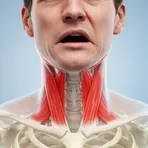
A thin flat muscle on each side of the neck that helps move the lower jaw and mouth
Surface Forms
Morphology
The meaning 'any of the skeletal muscles located in the face' is directly and compositionally derived from 'facial' (connected with the face) + 'muscle' (body tissue that produces movement). This simple descriptive noun–noun combination follows common cross-linguistic patterns, so a B1 learner who knows both constituents will readily understand the MWE.
Etymology
Facial muscle: The compound noun facial muscle comes from combining facial (relating to the 'face') and muscle (the parts that move the body). Imagine the thin bands under your skin that pull your mouth, eyes and brows to make 'expressions', so it means the muscles that move the face.