

eye muscle
 1
3.4
1
3.4

- noun
- /aɪ ˈmʌsəl/
- Specialized
- He exercises his eye muscles to improve his vision and reduce fatigue.
Examples
-
Close focus can become straining over time, so you'll want to look down your hallway at items further away so that your eye muscles can relax and work differently.
Blog text (13) -
Staring at the computer screen for too long can strain your eye muscles.
-
Your young daughter Angela's eye muscles are extremely weak.
-
It then forces your eye muscle inside the eye to sort of get a little bit closer to where you're trying to focus.
-
It strains your eye muscles.
-
Slight stiffening in the eye muscles, that's all.
-
And these neural lenses essentially help improve the efficiency of those eye muscles and reduce things like eye fatigue and eye strain.
-
One second I'll be looking at something, and the next moment my eye muscles will decide that the smudge on the wall is where I should be looking, and that'll be that.
Fiction book (2001) -
From the front seat, I watched the impassive face of my mother, the only glimmer of movement being the eye muscles moving back and forth to the rearview mirror.
Fiction book (1990) -
The doctor explained that certain conditions can weaken the eye muscles and affect vision.
Synonyms

 1
5.6
1
5.6
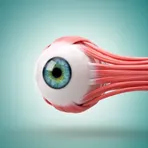
A small muscle around the eye that moves the eyeball
How Strong
- Specialized
1
3.4

- Specialized
Surface Forms
Morphology
The meaning 'muscle associated with the eye' is directly and transparently derived from combining 'eye' (the organ of vision) and 'muscle' (tissue that produces movement). This simple noun–noun composition denotes a part/association and follows regular compounding patterns found across many languages, so a B1 learner who knows both constituents will readily understand it.
Etymology
Eye muscle comes from the simple picture of a muscle by the eye that pulls the eyeball like a tiny rope. That's why it means 'a small muscle that moves the eye'.