
exudation
- noun
- /ˌɛksjuˈdeɪʃən/
- Specialized
- Unfortunately, no methods are currently available to determine the assimilation-exudation balances of mycorrhizae.
- assimilation and exudation
Examples
-
foul exudations of the human animal
Fiction book (1997) -
The first comparison places an upper limit on the amount of additional carbon that might be available through detritus production or root exudation.
Academic text (1998) -
Now the links were crusted with the dried exudations from Jabba's slobbering mouth.
Fiction book (1998) -
A third, and less frequently discussed process for conversion of DIN to soil organic nitrogen is through mycorrhizal assimilation and exudation.
Academic text (1998) -
We hypothesize (Figure 2c) that mycorrhizal assimilation and exudation is the dominant process involved in the immobilization of added nitrogen.
Academic text (1998) -
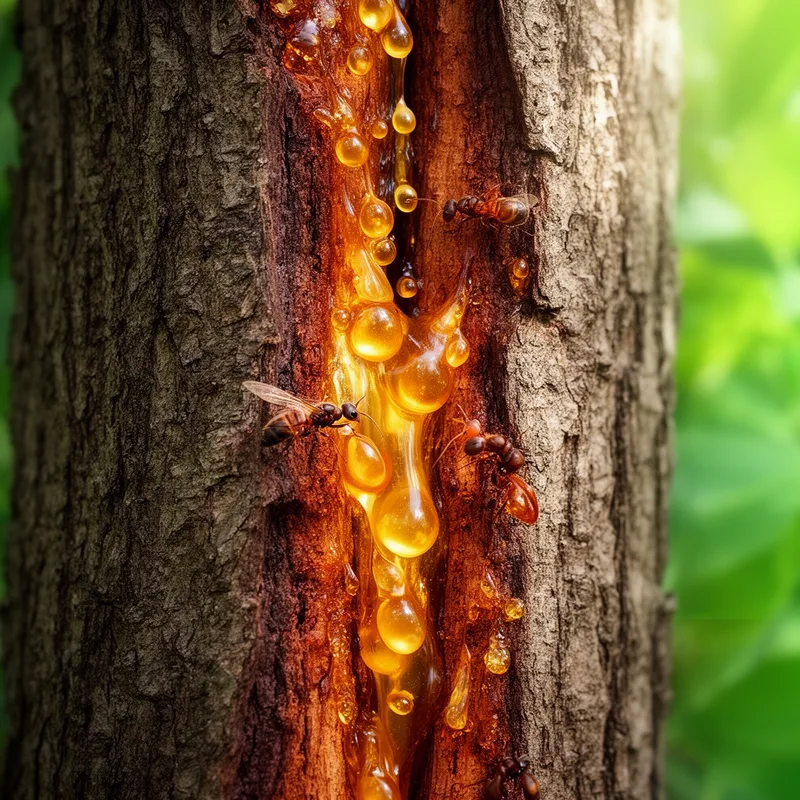
The plant's exudation formed a sticky residue on the surface of the leaves after the rain.
-
As a defense mechanism, the tree's exudation helped to seal the wound from insects.
-
The gardener noted the exudation from the injured bark, indicating that the tree was under stress.
Synonyms

 17
4.8
17
4.8

A substance made by a gland or cell and released to do a job in the body
 1
9.9
1
9.9
A liquid that comes out of a wound or plant after damage
Antonyms
How Thick

Surface Forms
Morphology
Etymology
Exudation comes from the Latin parts ex- 'out' and sudare 'to sweat', so a helpful image is a plant 'sweating' sticky drops out of its surface; that's why an exudation is the substance that oozes out from a plant or tree.