

extreme unction


 1
9.9
1
9.9
- noun
- /ɪkˈstrim ˈʌŋkʃən/
- Archaic
- At times, hara-kiri was as necessary to the Japanese as extreme unction is to a devout Catholic.
Examples
-
However, I still maintain that receiving extreme unction four times in one lifetime is excessive.
Fiction book (2002) -
They are giving him extreme unction.
-
That's why Father Martin is going on and on about how the rite has changed its name from "extreme unction" to the "anointing of the sick."
Fiction book (1997) -
The Church administered a sacrament called extreme unction to the dying, as a sort of booster shot of holiness right before approaching the pearly gates.
Academic text (2010) -
She was receiving extreme unction from a well-endowed, if aged, prelate whose high station in the hierarchy of the Church was identifiable only by the miter perched on his head.
Fiction book (1992) -
The priest offered extreme unction to the dying man in hopes of ensuring his salvation.
-
During the ceremony, the family gathered as the priest administered extreme unction to their loved one.
-
In moments of finality, many seek the comfort of extreme unction as part of their faith.
Synonyms
 16
7.2
16
7.2
A religious ceremony for a person who is dying or has just died
 1
9.9
1
9.9
An act of putting oil on someone during a religious ceremony

A Roman Catholic ritual where a priest puts oil on a very sick person and prays for comfort
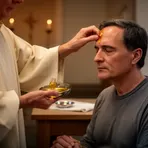
An act of putting oil on a person during a religious or healing ceremony
Surface Forms
Morphology
The constituent 'unction' directly names the ritual act (anointing) and 'extreme' can be interpreted as referring to the final or utmost occasion, so a learner who knows both words gets a strong clue that this is a special anointing. However, the phrase is specialized, somewhat archaic and tied to a specific sacramental practice (last rites), and the sense of 'extreme' as 'final/at death' is not fully transparent to an average B1 learner without cultural/religious knowledge, so the meaning is only partly predictable.
Etymology
The noun extreme unction comes from the old church practice of a priest rubbing oil on a person at the very end of life. The word extreme meant 'last' and unction meant 'anointing' or 'rubbing with oil', so the picture of that final blessing explains why the phrase means the sacrament given to someone who is dying.