
extrasolar
 5
7.4

- adjective
- /ˌɛkstrəˈsoʊlər/
- Specialized
- In one particular case, the extrasolar planet HD209458b was observed to eclipse its central star.
- extrasolar planets
- extrasolar planetary system
- discovery of extrasolar planets
Examples
-
The orbital periods of the extrasolar planets range from just three days to a few years.
Academic text (2000) -
The newly discovered free-floaters also seem to have the same mass as some accepted extrasolar planets.
Academic text (2003) -
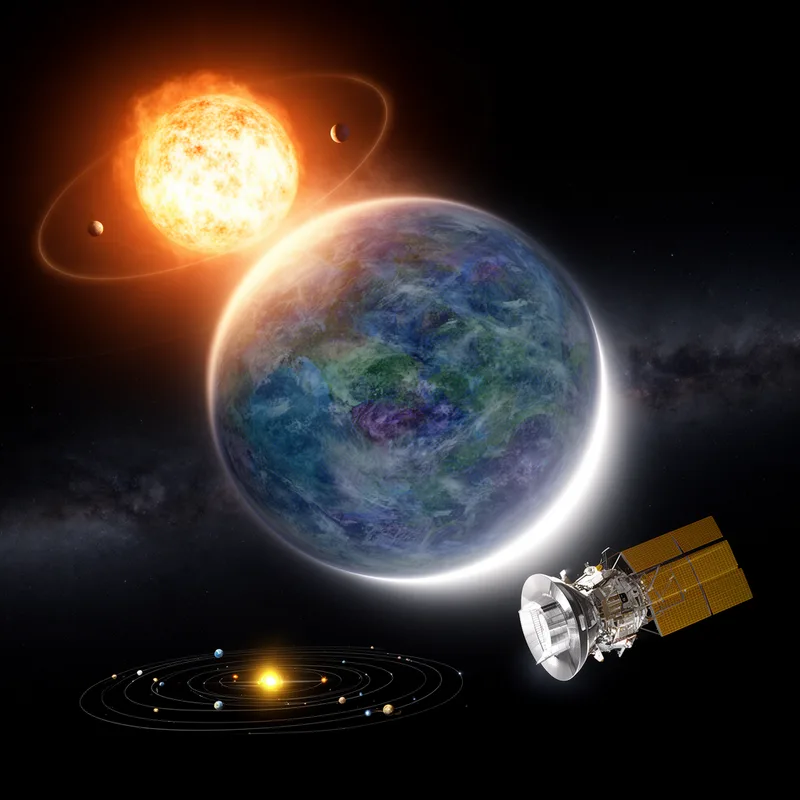
Here is an artist's conception of an extrasolar planet passing in front of its parent star.
Academic text (2000) -
The novelty of finding an extrasolar planet may have worn off.
Academic text (2000) -
Now the discovery of such "extrasolar" worlds threatens to become routine.
Academic text (2000) -
The James Cook University's Centre for Astronomy is also involved in the search for extrasolar planets.
Academic text (2007) -
As of May 2000, 42 extrasolar planets had been discovered by Doppler surveys.
Academic text (2000) -
Even with the discovery of so many extrasolar planets, astronomers yearned for more information.
Academic text (2000) -
Most dramatic of all, however, are the discoveries of extrasolar planets practically in our Galactic backyard.
Academic text (2000) -
Astronomers discovered an extrasolar planet that orbits a distant star outside our solar system.
Surface Forms
Morphology
Etymology
Extrasolar comes from extra- meaning 'outside' and solar meaning 'of the Sun', like the everyday word extra and the word solar. So extrasolar describes something that is 'outside the solar system'.