
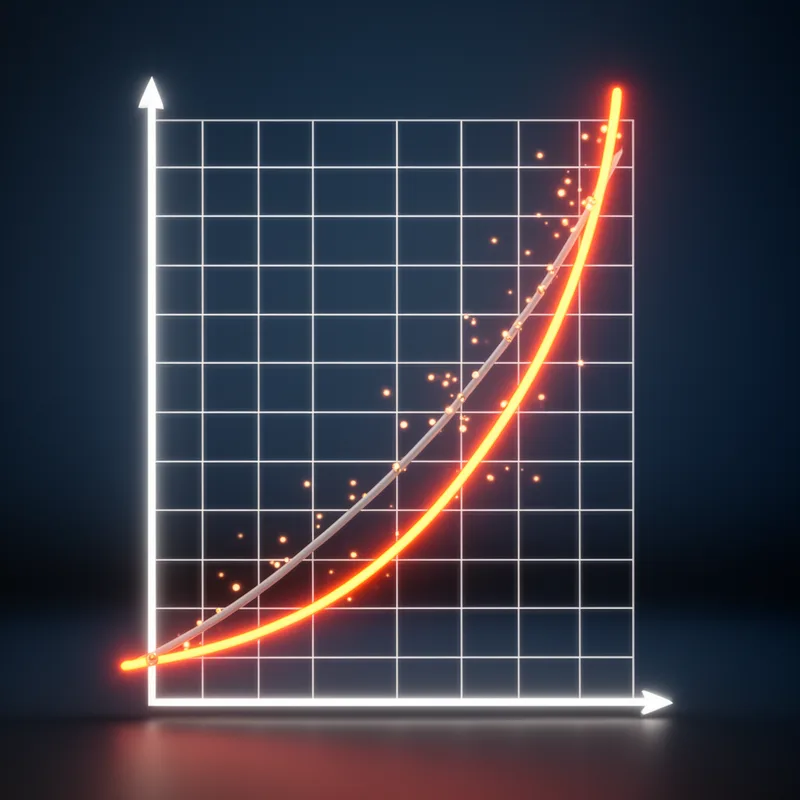
exponential
 1
8.1
1
8.1

- noun
- /ˌɛkspəˈnɛnʃəl/
- Specialized
- The graph of an exponential shows a rapid increase as the value of x rises.
Loading YouTube…
Watch on YouTubeFor trig functions like straight up sine cosine E stands for exponentials like E to the X.
- For trig functions like straight up sine cosine E stands for exponentials like E to the X.
Examples
-
Here we would have an exponential minus T decay.
-
All data from time-resolved measurements were fitted globally to a sum of exponentials using a sequential kinetic scheme with increasing lifetimes.
Academic text (2018) -
The number of states is the exponential of the number of bits.
-
The fourtieth step in an exponential progression is a trillion.
-
That's the CDF of an exponential of one, right?
-
The use of other potential functions (for example, exponentials) instead of the above function would produce a model having different characteristics.
Academic text (1995) -
Exponentials are seen, for example, in force distributions in glassy materials, foams, and sand piles.
Academic text (2001) -
The exponential has a long tail extending to large amplitudes so that, rarely, a signal can scintillate to a strength that is much larger than its true strength in the absence of scintillations.
Academic text (1999) -
An exponential function can be expressed as f(x) = a^x, where a is a constant.
-
In mathematics, the value of e raised to the power of x is an example of an exponential function.
Synonyms


 1
6.8
1
6.8
A rule that gives a number by raising a fixed number to a variable's power
Compounds

- Specialized
1
6.8
A rule that gives a number by raising a fixed number to a variable's power

- Specialized
1
6.8
A decrease where an amount falls by the same part over equal times, becoming much smaller over time


Surface Forms
Etymology
Exponential comes from exponent, which has the parts ex- 'out' and ponere 'to put'; an exponent is the small number that 'shows' how many times to multiply a base number. So an exponential (a math function) is one where that small number controls the result and the values can grow very quickly.