
ethnobiology
- noun
- /ˌɛθnoʊbaɪˈɑlədʒi/
- Specialized
 :
etnobiología
:
etnobiología
- Major issues in ethnobiology now include intellectual property rights (with variants like bioprospecting and benefit sharing), the Human Genome Project, and protected areas with people (such as biosphere reserves).
- ethnobiology and geography
- linguistic ethnobiology
Examples
-
A promising web of connections is being interwoven between geography and ethnobiology, longtime cognate fields.
Academic text (2001) -
Another overlap of geography and a linguistics-inflected ethnobiology comes where landscape-based livelihoods meet ethnobiological knowledge.
Academic text (2001) -
Not least, the new interweaving of ethnobiology and geography can bring further light to the use of computerized technologies in environmental research and policy.
Academic text (2001) -
This builds on the strong linguistic emphasis of modern ethnobiology; in fact, one of its present-day pillars.
Academic text (2001) -
Unlike older ethnobiology, the new works see knowledge of environments as culturally conditioned in both the vernacular and scientific contexts.
Academic text (2001) -
"Ethnolandscape ecology" is a term that effectively entwines the new melding of geography and ethnobiology in the research under review.
Academic text (2001) -
Today, closer contact of linguistic-centered ethnobiology with geography is spurred through the former's deepening awareness of the human role in nature and, especially, the qualities of environments as modified by human action.
Academic text (2001) -
Posey's ample vision helped to incorporate this view of ethnobiology as human-environment interaction into the 1988 activist-inspired Declaration of Belm by the International Society of Ethnobiology.
Academic text (2001) -
Leading scholars and activists, such as Darrell Posey, have viewed ethnobiology as distinguished by the general aim of seeking to understand the relations of human societies and their environments (ICE 2000).
Academic text (2001) -
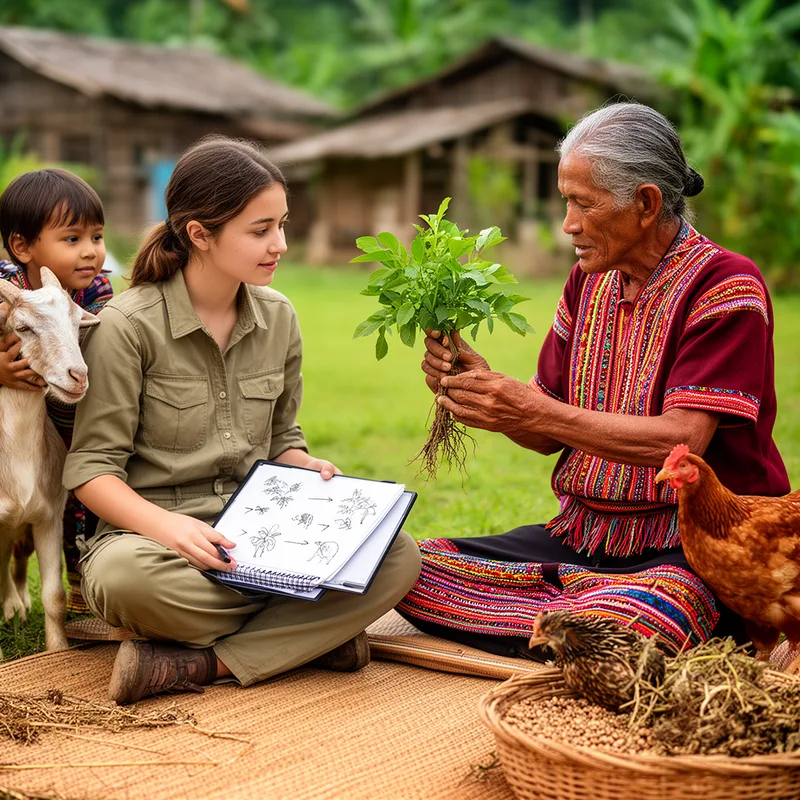
The study of ethnobiology helps us understand how indigenous cultures use plants and animals in their environment.
Surface Forms
Morphology
ethnobiology = biology (semi-transparent) = ethno + bio + logy
The word is transparently built from 'biology' with ethno-, but the exact disciplinary scope is somewhat specialized.
Etymology
The word ethnobiology is made of three parts: ethno- meaning 'people', bio- meaning 'life', and -logy meaning 'study'. So ethnobiology is the study of how different people use, name, and understand plants and animals in their environment.

