
ethidium


 1
8.9
- noun
- /ˈɛθɪdiəm/
- Specialized
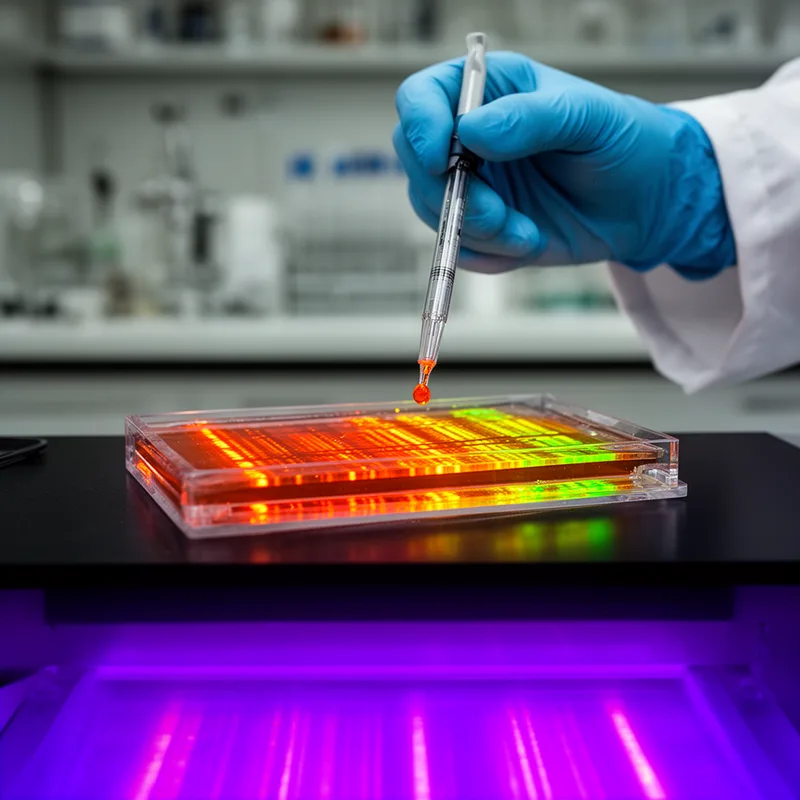
- The gel was stained with ethidium bromide to visualize the DNA bands during the experiment.
- ethidium bromide
- ethidium-stained gel
Examples
-
Following amplification, PCR products were electrophoresed in 1.5% agarose gels stained with ethidium bromide and visualized under ultraviolet light.
Academic text (2018) -
Following electrophoresis, the gel was stained for 15 minutes in ethidium bromide solution and destained for 10 minutes in distilled water.
Academic text (2002) -
Results were recorded as positive if a 596 bp band was visible on the ethidium-stained gel.
Academic text (1992) -
The PCR products were stained with ethidium bromide and examined after electrophoresis through a 1.5% agarose gel.
Academic text (2012) -
The amplified product was analyzed by electrophoresis on a 2% agarose gel after ethidium bromide staining.
Academic text (2012) -
Amplification products were analyzed after electrophoresis on a 1% agarose gel stained with ethidium bromide.
Academic text (2012) -
PCR products were analyzed by electrophoresis on 2% agarose gels, followed by ethidium bromide staining.
Academic text (1992) -
PCR products were visualized by electrophoresis through 1.5% (w/v) agarose containing 0.5 mg/L ethidium bromide.
Academic text (2001) -
After running the samples, the researchers used ethidium to illuminate the separated DNA fragments.
-
During the analysis, the DNA was clearly visible thanks to the ethidium staining method applied to the gel.
Synonyms
 1
9.8
A chemical that glows under a microscope to stain cells
Surface Forms
Etymology
Ethidium starts with eth-, the same piece you see in ethanol, and ends with -ium, a common ending for lab chemicals. A helpful way to remember it is to think of ethidium as a small chemical 'dye' that 'lights up' DNA under UV light, which is exactly why scientists use it to stain and see DNA.