
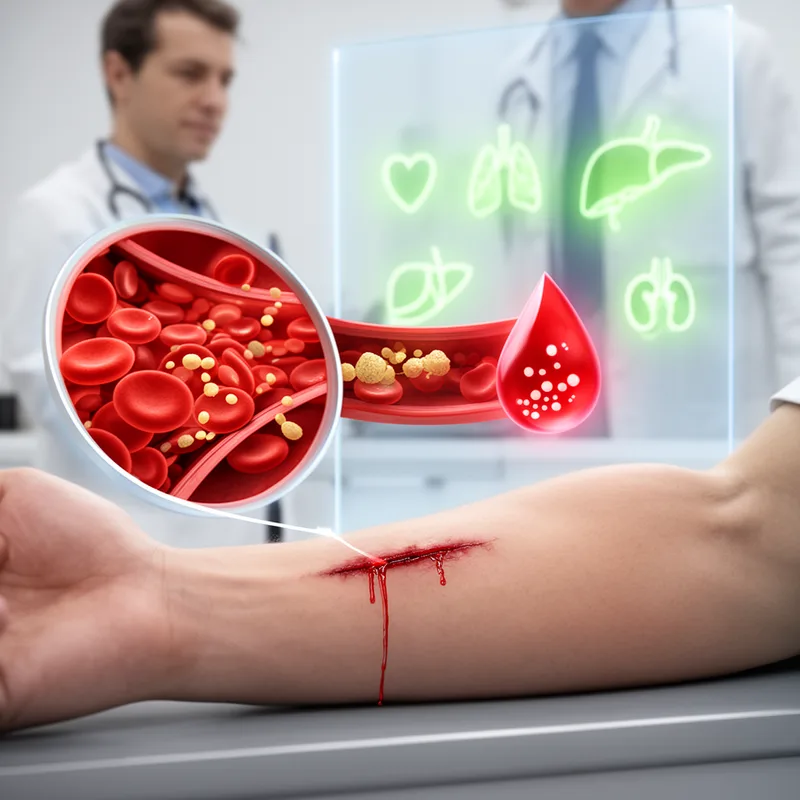
essential thrombocytopenia
- noun
- /ɪˈsɛnʃəl θrɒmbəˌsaɪtəˈpiːniə/
- Specialized
- The patient was diagnosed with essential thrombocytopenia after blood tests showed a significantly low platelet count.
Examples
-
The patient was diagnosed with essential thrombocytopenia after other causes were ruled out.
-
Doctors monitor blood counts closely in cases of essential thrombocytopenia to prevent complications.
-
Research into essential thrombocytopenia has led to new treatment approaches in hematology.
-
Patients with essential thrombocytopenia often experience fatigue.
-
What are the symptoms of essential thrombocytopenia?
-
Doctors often recommend regular evaluations for essential thrombocytopenia to manage the risk of bleeding complications.
-
Understanding essential thrombocytopenia can help patients make informed decisions about their treatment options.
Synonyms

 1
9.9
1
9.9

A low number of small blood cells that help stop bleeding
A condition that causes easy bruising and bleeding because the blood has very few platelets for no known reason

A low number of tiny blood parts that help stop bleeding
Antonyms

- Specialized
An increase in the number of platelets, tiny blood cells that help clot blood, which can cause dangerous clots
Surface Forms
Morphology
The phrase is compositionally analyzable: 'thrombocytopenia' means low platelets and 'essential' marks a subtype, so a learner who knows both words can infer it refers to a particular form of thrombocytopenia. However, the medical use of 'essential' to mean 'primary/idiopathic (not caused by other diseases)' is a technical nuance beyond the everyday meaning of 'essential', making full interpretation unlikely for an average B1 learner without medical knowledge.
Etymology
Essential thrombocytopenia is a medical name made of two parts: essential meaning 'primary' or not caused by something else, and thrombocytopenia meaning 'too few platelets', with platelets being tiny blood cells that help stop bleeding. So the name means a main condition where the blood has too few platelets.