
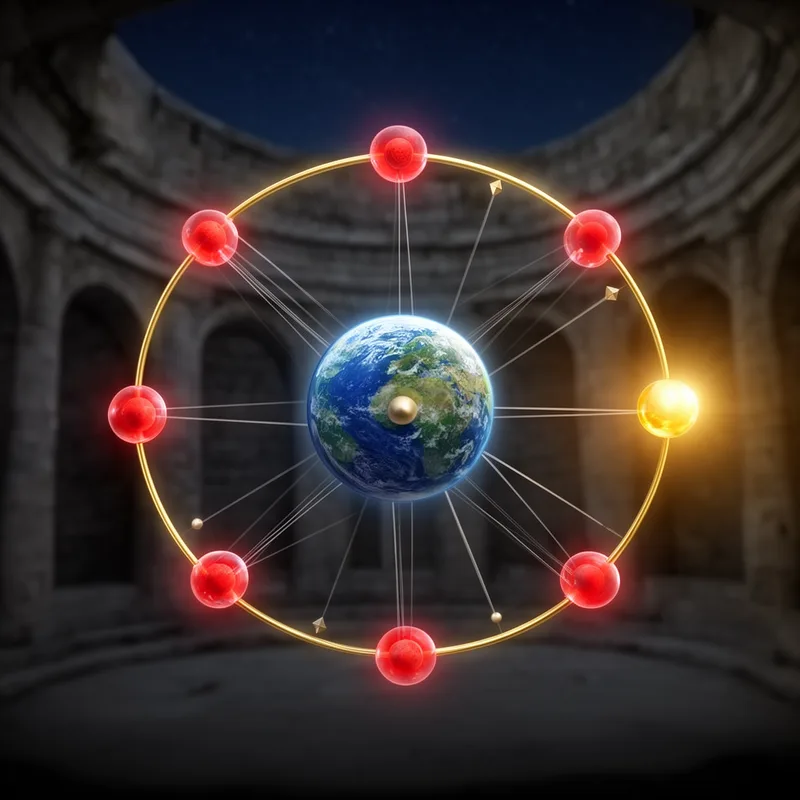
equant


 1
9.9
- noun
- /ˈiːkwənt/
- Archaic
- In Ptolemaic astronomy, the equant was used to explain the irregular speed of planets.
Examples
-
The concept of the equant helped ancient astronomers model planetary motion more accurately.
-
Modern astronomy no longer uses the equant, but it was essential in historical models.
-
The equant was crucial in Ptolemaic astronomy.
-
An equant helps illustrate uniform planetary motion.
-
In Ptolemaic models, the equant was crucial for illustrating how planets move at varying speeds.
-
Ancient astronomers relied on the equant to simplify the complex movements of celestial bodies.
-
The use of the equant allowed astronomers to depict planetary orbits in a more uniform manner.
Surface Forms
Morphology
equant = equal (opaque) = equa + ant
Although historically related to 'equal', the astronomical technical sense (a point producing apparent uniform motion) is specialized and not inferable from 'equal' by an average learner.
Etymology
Equant in astronomy comes from Latin aequus 'equal' because it was a special point that made a planet's motion look like it moved at an 'equal' or steady speed from that view. That's why the equant was used to help explain uneven planetary motion.