
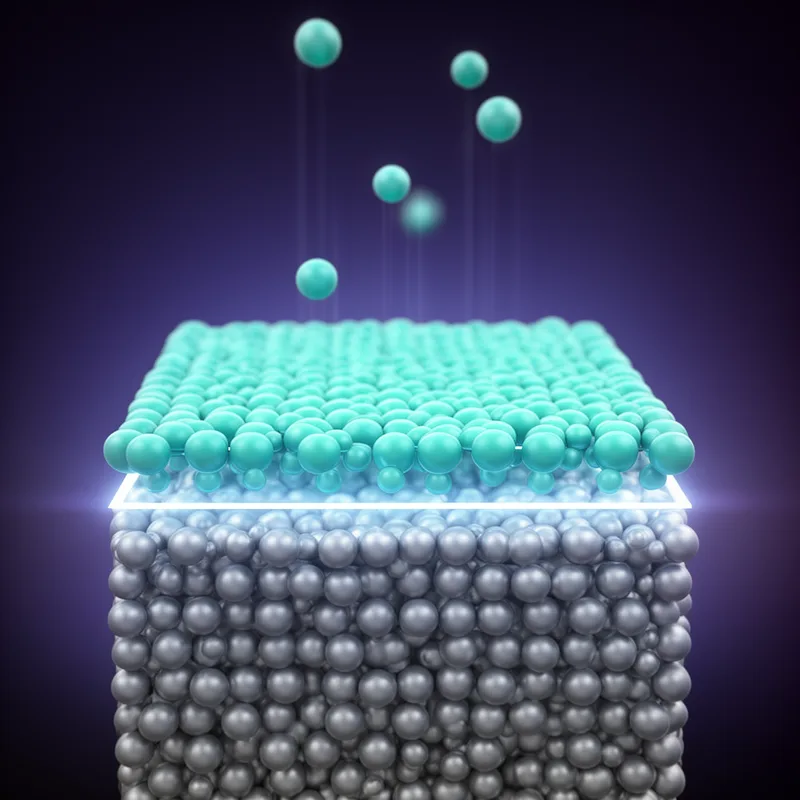
epitaxial


 1
9.9
- adjective
- /ˌɛpɪˈtæksiəl/
- Specialized
- The evolution of roughness at the growth front in both epitaxial and nonepitaxial films is an extremely active area of investigation, both experimental and theoretical.
- epitaxial growth
- epitaxial film
- epitaxial QDs
Examples
-
The new research shows that epitaxial layers can significantly improve the performance of semiconductor devices.
-
Transport of atoms over and along steps is the controlling factor in epitaxial film growth technology because of its influence on the crystal quality of the film.
Academic text (1993) -
Details about those processes contribute to the fundamental understanding of epitaxial growth of thin films.
Academic text (2006) -
The book also provides details on various methods to grow graphene, including epitaxial, CVD, and chemical methods.
Blog text (23) -
This high degree of local epitaxial growth is expected to translate into strong adhesion of the overall coating.
Academic text (2018) -
Another advantage of epitaxial QDs is that they lie far beneath the surface of the surrounding material, whose associated states are potentially meddlesome.
Academic text (2002) -
"Downward" crossing of steps, reminiscent of rain filling valleys and lakes, is an essential component of epitaxial growth.
Academic text (1993) -
For example, achievement of good performance in electronic or optoelectronic devices frequently requires fabrication of epitaxial films of covalent materials with thicknesses in some cases as small as a few atomic layers.
Academic text (1993) -
When a multiple heterostructure with two thin GaAs layers is prepared by epitaxial growth techniques such as molecular-beam epitaxy or metal-organic chemical vapor deposition, a double quantum well forms.
Academic text (1994) -
The scientists used epitaxial techniques to create a flawless crystal structure on the substrate.
Surface Forms
Morphology
Etymology
Epitaxial comes from the Greek parts epi- 'upon' and taxis 'arrangement' (the same root as taxonomy). A helpful way to remember it is to think of an epitaxial layer as a thin sheet grown 'upon' a surface with its structure lined up to match the order below, which is why it must fit the material underneath.