
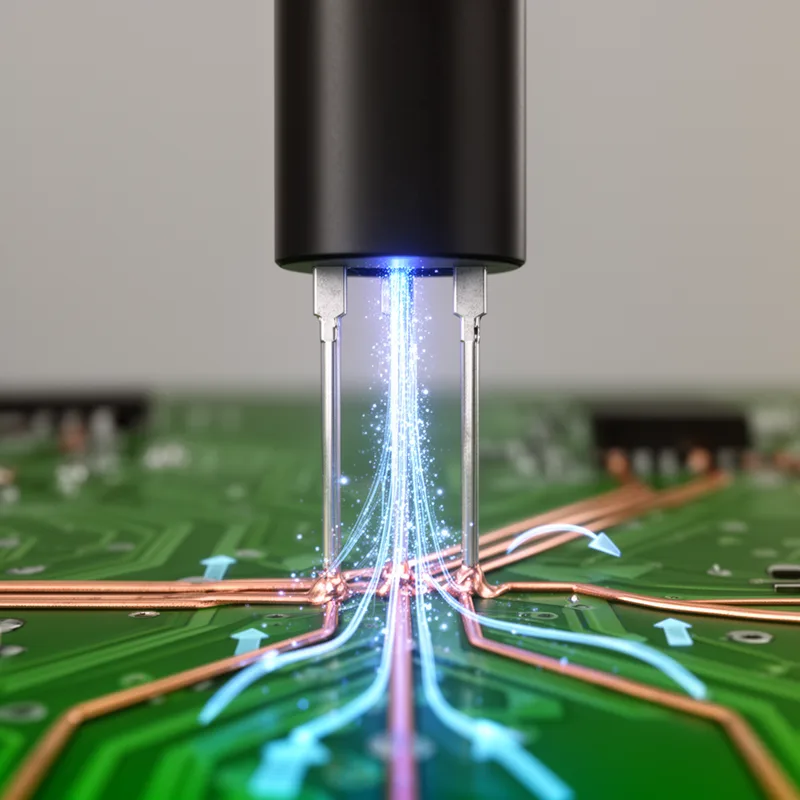
emitter
 3
7.5
3
7.5

- noun
- /ɪˈmɪtər/
- Specialized
- When measuring the voltage, the emitter terminal must be connected to the ground for accurate readings.
- emitter surface
Examples
-
In a transistor circuit, the emitter is responsible for injecting charge carriers into the base.
-
And so just so we know what they are, there's an emitter, a base and a collector.
-
So if you have this is your emitter, you have a contact here and a contact here.
-
You can see there between the emitter and the base, between the base and the emitter, there's no reading.
-
And then the current is flowing out of the emitter back-to-back to ground over here.
-
And then you'll have an emitter, a base and a collector.
-
And then we have common emitter single transistor amplifiers and they're coupled together with this pot here.
-
The bipolar transistor (a) functions by emitting electrons across a low-impedance, forward-biased emitter junction into the base region.
Academic text (1997) -
The engineer replaced the faulty emitter to ensure that the circuit functioned properly.
Surface Forms
Morphology
Etymology
Emitter comes from the Latin emittere, made of e- 'out' and mittere 'to send', like in transmit or the simple word 'send'. So, in a transistor, the emitter is the part that 'sends out' charge into the circuit.