

eleuthera bark
- noun
- Specialized
- Traditional healers often prepare tonics from eleuthera bark to aid digestion and relieve minor ailments.
Examples
-
Incense crafted with eleuthera bark is prized for its distinctive fragrance in ceremonial practices.
-
The distillery uses eleuthera bark to impart a subtle, spicy aroma to its liqueurs.
-
I bought some eleuthera bark for my herbal remedies.
-
The eleuthera bark is known for its aromatic properties.
-
Incense crafted with eleuthera bark is prized for its distinctive fragrance in ceremonial practices.
-
Traditional healers often prepare tonics from eleuthera bark to aid digestion and relieve minor ailments.
-
The distillery uses eleuthera bark to impart a subtle, spicy aroma to its liqueurs.
Synonyms
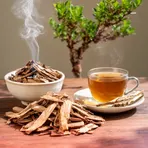
A fragrant bark from a small shrub for making incense and health drinks

Fragrant bark from a tropical tree used for incense and traditional medicine
Surface Forms
Morphology
eleuthera + bark
The phrase is a simple noun+noun composition meaning 'the bark of eleuthera' (i.e., the bark from the plant/place called Eleuthera), so a learner who knows the constituent meanings would infer it refers to that plant's bark. Specific properties like its aromatic or tonic uses are lexical extras that require exposure, but the basic referential meaning is compositionally transparent and common cross-linguistically.
Etymology
Eleuthera bark may come from the island of Eleuthera, where people gathered the shrub's strong-smelling bark. People used that bark to make a 'tonic' and to burn as 'incense', so the name now means the strong-smelling bark used for healing and ceremonies.

