
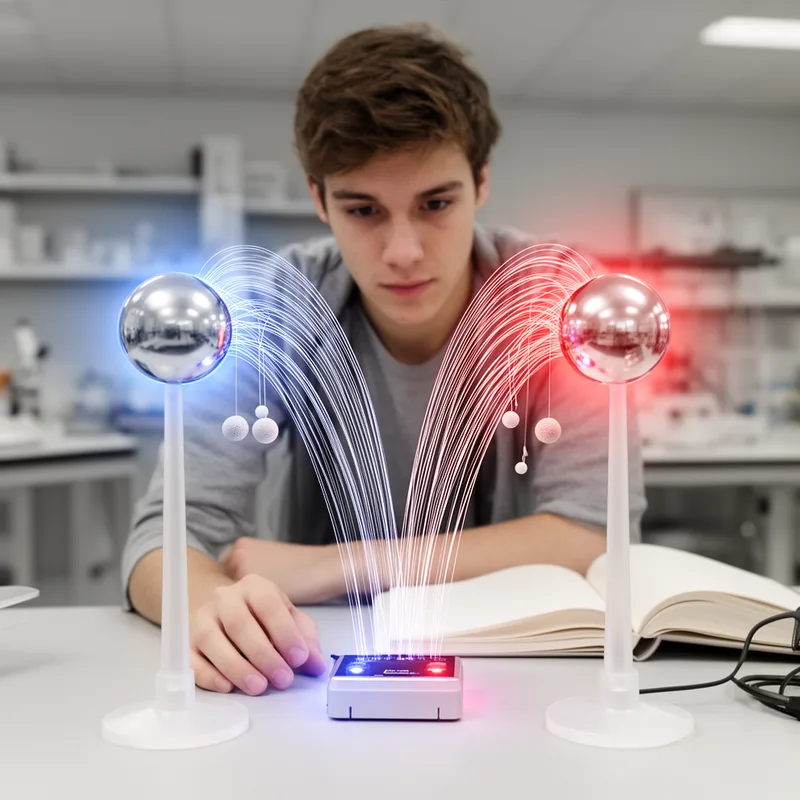
electrostatics
 1
8.6

- noun
- /ˌɛlɛkˈtroʊˌstætɪks/
- Specialized
- Micromachines come in many shapes and sizes but use only the actuating principles of electrostatics and magnetics, piezoelectrics, and thermal energy.
Loading YouTube…
Watch on YouTubeOn the subatomic level, I feel that there is a dimension shift activated by very conventional electrostatics, RF.
- On the subatomic level, I feel that there is a dimension shift activated by very conventional electrostatics, RF.
Examples
-
The authors begin by carefully constructing a microscopic vision of electrostatics and DC circuits, using only the concepts of Coulomb's law and the electric field.
Academic text (1996) -
Think of them as separate electrostatics problems.
-
We're going to couple electrostatics and chemistry.
-
Theoretical problem 1 was designed to link electrostatics with current electricity and a little bit of circuits.
Academic text (1993) -
"For a long time, engineers thought that electrostatics was the way to go in building microactuators," said Mark Allen, a research engineer at Georgia Tech.
Academic text (1994) -
Software that analyzes multiple physical phenomena like fluid flow and electrostatics helps mechanical and electrical engineers collaborate with greater ease.
Academic text (2003) -
Her research program focuses on the self-assembly of polymeric nanomaterials; the core of her work is the use of electrostatics and other complementary interactions to generate functional materials with highly controlled architecture.
Blog text (13) -
Understanding electrostatics is essential for explaining how static electricity can cause objects to attract or repel each other.
-
In physics class, we learned that electrostatics involves studying electric charges at rest and the forces acting between them.
-
The principles of electrostatics are crucial for designing devices that rely on electric charges, such as capacitors.
Surface Forms
Morphology
Etymology
Electrostatics comes from the Greek electron ('amber'), the same root as electricity, because people first saw electric effects when rubbing amber, and from statics ('standing' or 'still'). So electrostatics is the study of electric charges that are 'standing' or not moving.