
electroencephalography
 1
7.1

- noun
- /ˌɛlɛkˌtroʊˌɛnˈsɛfələˌɡrəfi/
- Specialized
- Another major difference is the use of electroencephalography instead of intracranial electrodes or receivers that must be implanted surgically into the brain.
- electroencephalography (EEG)
Examples
-
Using electroencephalography (EEG), a method used to record the activity of large groups of neurons, the researchers were able to measure the difference in brain activity during correct and illusory perception.
Blog text (16) -
While they were completing the go/no-go task, the participants' brain activity was recorded using electroencephalography, or EEG.
Blog text (11) -
But the CLEM test has a high correlation with electroencephalography.
Academic text (2010) -
The electrodes pick up brain signals from the scalp based on a technique called electroencephalography.
Academic text (2007) -
The most commonly used technologies include electroencephalography, event-related potential, magnetoencephalography, positron emission tomography, and functional magnetic resonance imaging (fMRI).
Academic text (2012) -
Electroencephalography demonstrates excessive diffuse slowing of theta and delta waves, and an occasional triphasic wave, suggestive of a mild diffuse encephalopathy.
Academic text (2004) -
During the experiment, doctors used electroencephalography to monitor the patients' brain activity.
-
The electroencephalography test revealed unusual patterns in the electrical activity of the brain.
-
Researchers recorded the electrical impulses in the brain with electroencephalography to study sleep patterns.
Surface Forms
Morphology
electroencephalography = electro + encephalo + graphy
The word is largely compositional from the scientific combining forms electro-, encephal(o)-, and -graphy, but the specialized medical meaning makes it only partly transparent for average learners.
Etymology
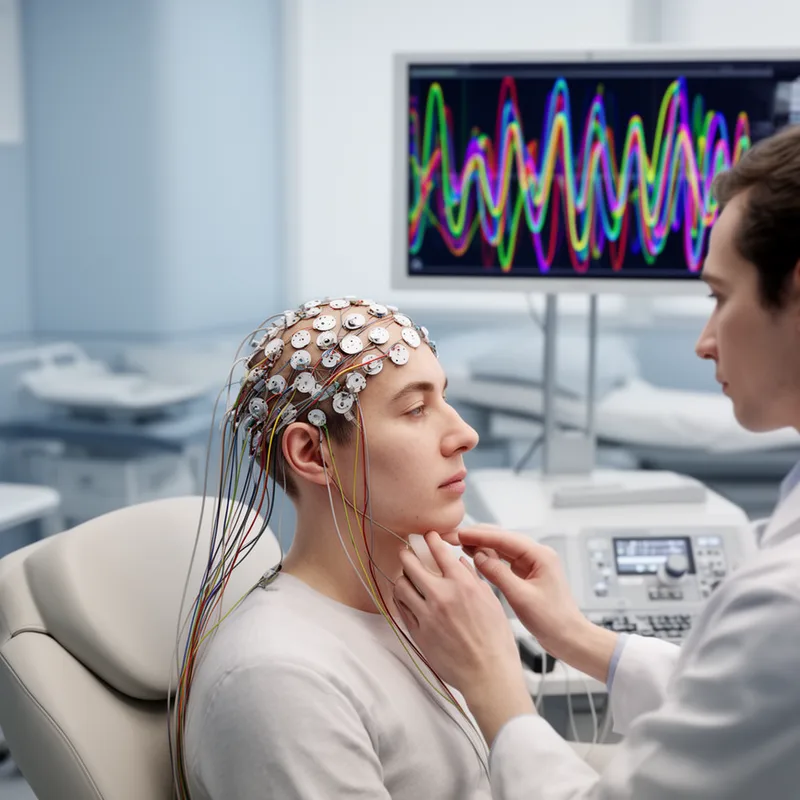
The word electroencephalography breaks into electro- 'electric', encephalo- 'brain', and -graphy 'recording', and the -graphy part is the same ending you see in 'photography'. So, electroencephalography is a test that records the brain's electrical activity.