
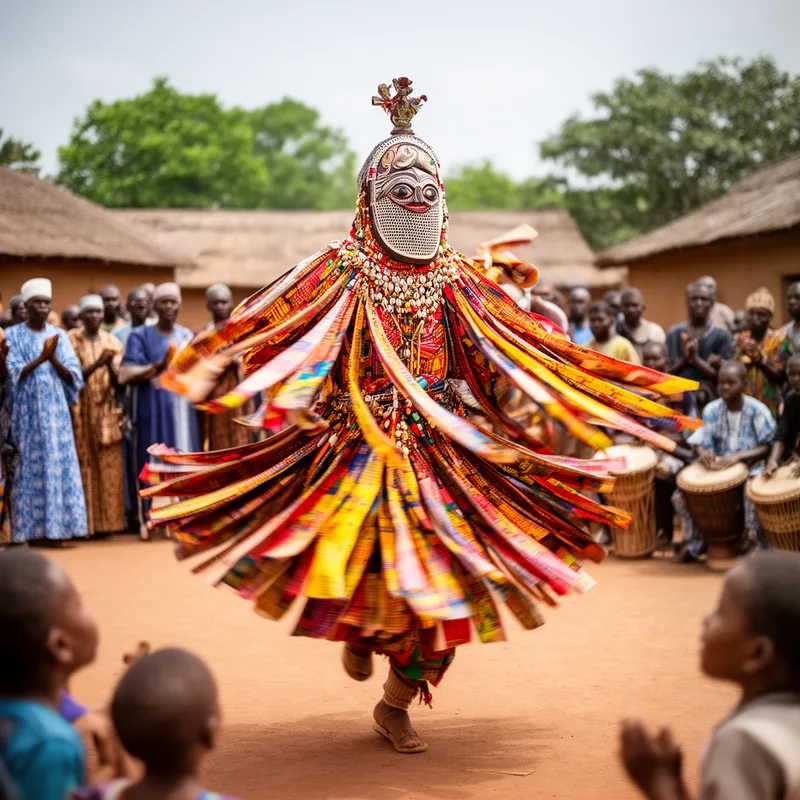
egungun


 1
9.9
- noun
- Yoruba-speaking peoples of southwestern Nigeria and southeastern Benin hold annual or biennial Egungun festivals to honor lineage ancestors and request their blessings.
- Egungun costume
- Egungun masquerade
- Egungun mask
Examples
-
The second means of honoring ancestors in Oyotunji is the Egungun masquerade (Fig. 9).
Academic text (1991) -
In Egungun, the layers of cloth strips hide the masquerader's body during sacred dances for the ancestors.
Academic text (1996) -
The composition of an Egungun ensemble has several distinctive features.
Academic text (1995) -
Their relationship to the deceased is much the same as that of Egungun maskers.
Academic text (1990) -
After all the Egungun have danced, the ensembles are stored until the next performance.
Academic text (1995) -
The Egungun ensemble acts as the medium for the masker's transformation into his ancestors.
Academic text (1995) -
In Yoruba performances of Egungun, masks portray spirits of ancestors rather than the physiognomies of deceased persons (Fig. 10).
Academic text (1990) -
During the festival, the egungun dancer performed with colorful costumes to honor the ancestors.
-
The egungun masks are crafted with intricate designs that reflect the lineage of the family.
-
In Yoruba culture, an egungun ceremony involves rituals where the spirits of the ancestors are celebrated.
Surface Forms
Etymology
Egungun comes from the Yoruba language of West Africa, where the part egun means 'ancestors' or 'the dead'. A helpful way to remember it is as 'masked ancestors'—performers put on masks and tall costumes and are believed to become the ancestors during festivals, which is why egungun can mean the spirit, the costume, or the person who wears it.