
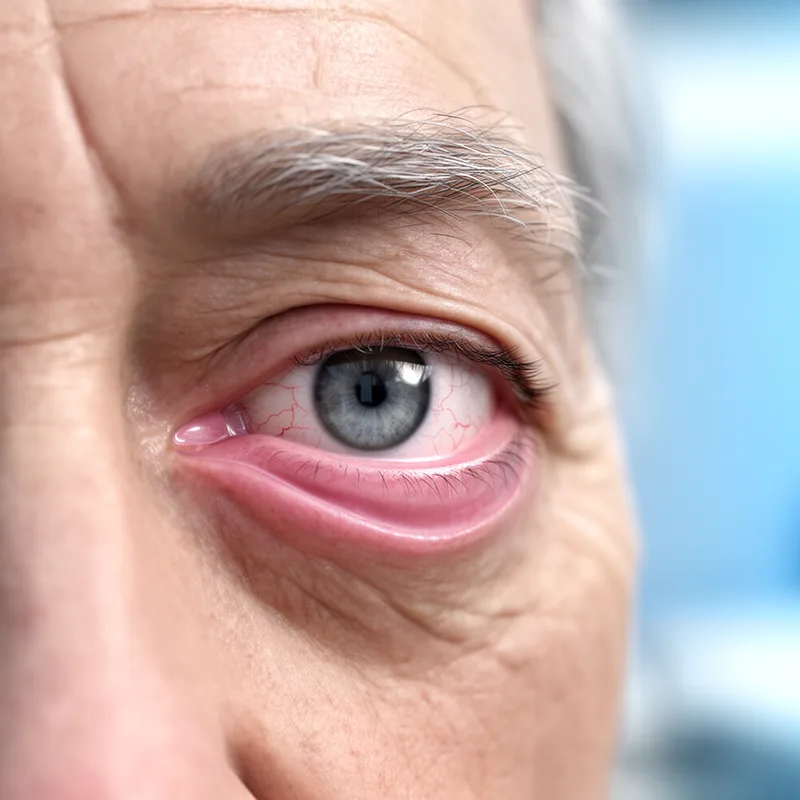
ectropion
- noun
- /ɛkˈtroʊpiən/
- Specialized
- Patients suffering from ectropion often experience discomfort due to the sensitive inner eyelid being exposed.
Examples
-
Ectropion can cause the eyelid to turn outward, leading to exposure of the inner surface.
-
The doctor explained that ectropion might result in irritation from wind and dust exposure.
-
No patients experienced ectropion, infection, bleeding, or blindness.
Academic text (2011) -
The lower lip outstretches with ectropion, as if to compensate for the failure of the upper lip.
Academic text (1996) -
An ectropion formed, and the young Thomas began to wear an eye patch to keep the cold air out and to stop others from staring at it (Carter, 1991; Jones, 2003).
Academic text (2010) -
The patient had severe scaling of his feet and hands, yellow discoloration of his nails, and bilateral ectropion with purulent discharge.
Academic text (2007) -
None of the patients were exposed to the operative risks of ectropion, infection, implant extrusion, bleeding, or blindness.
Academic text (2011) -
A disadvantage of the nasolabial V-Y advancement flap is the possibility of cicatricial ectropion in the long term if not designed properly.
Academic text (2015) -
Reported complications of orbital floor reconstruction include persistent ophthalmic dysfunction, ectropion (15), poor scarring, infection, implant extrusion, and even blindness (16, 17).
Academic text (2011) -
Maintaining the natural concavity of the region with no distortion of the surrounding tissue, achieving symmetry, and protecting the visual field and eyelid movements without cicatricial ectropion must be considered during reconstruction (4, 5).
Academic text (2015)
Surface Forms
Etymology
Ectropion comes from Greek parts ec- meaning 'out' and -tropion meaning 'turn'. So an ectropion of the eyelid is easy to imagine: the edge 'turns out', exposing the inner surface and causing irritation or dryness.

