
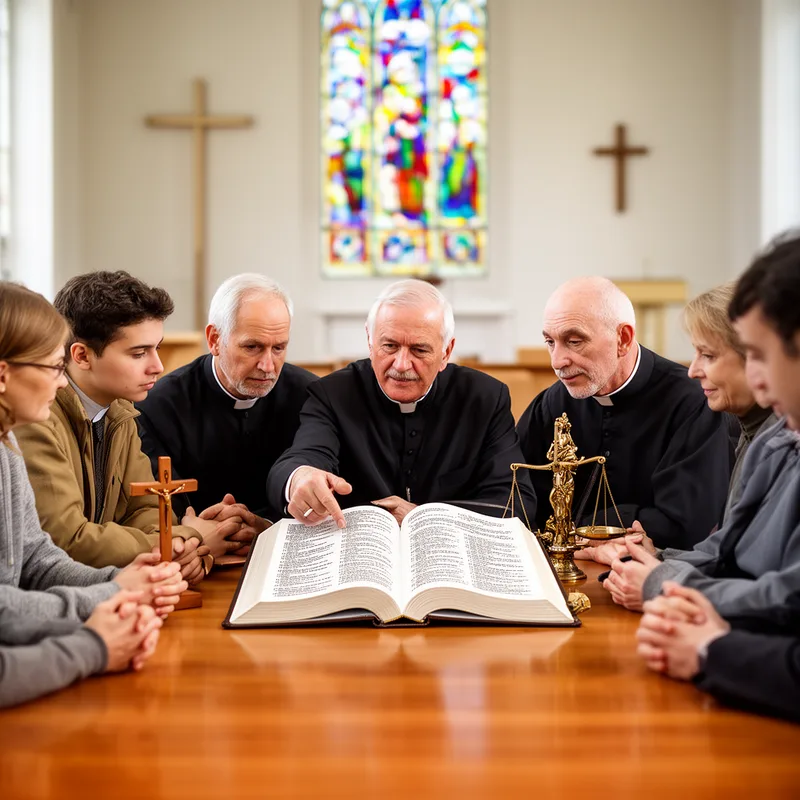
ecclesiastical law


 1
9.5
1
9.5
- noun
- /ɪˌkliːziˈæstɪkəl lɔː/
- Formal
- Many Christian communities adhere to ecclesiastical law for issues like marriage and baptism.
Examples
-
Every part of the incident concerns ecclesiastical law.
-
The important thing is that ecclesiastical law no longer asserts the wearing of chapel veils.
Blog text (23) -
The pastoral care of the present church in terms of the Mass and the sacraments, and the growth of the future church, are being sacrificed for the sake of ecclesiastical law.
Academic text (1994) -
It is painful, of course, to watch the State's definition of marriage careen toward something unrecognizable under natural or ecclesiastical law, but eliminating true marriages from the pool of unions treated as marriage by the State is not the solution to the State's errors.
Blog text (9) -
The church's decisions are guided by ecclesiastical law to ensure fair governance.
-
In church disputes, ecclesiastical law serves as an essential framework for resolving conflicts.
Synonyms
 4
8.9
4
8.9
Rules made by a Christian church to govern its members
How Binding
- Specialized
4
8.9

- Formal
1
9.5
- Formal
148
1.3
344
3.1
Surface Forms
Morphology
The meaning is directly compositional: 'ecclesiastical' means 'related to the Christian church' and 'law' means statutes or rules, so together they clearly mean laws governing the church. This follows a common 'X law' pattern (and has obvious cognates in many languages), so a B1 learner who knows both constituents should be able to infer the MWE's meaning.
Etymology
The term ecclesiastical law comes from ecclesiastical, meaning 'church', and law, meaning 'rules'. Long ago, church leaders made special rules to run services and daily life, and these 'church rules' became a separate system of law. So ecclesiastical law today means the rules made by Christian churches to govern their organization and work.