
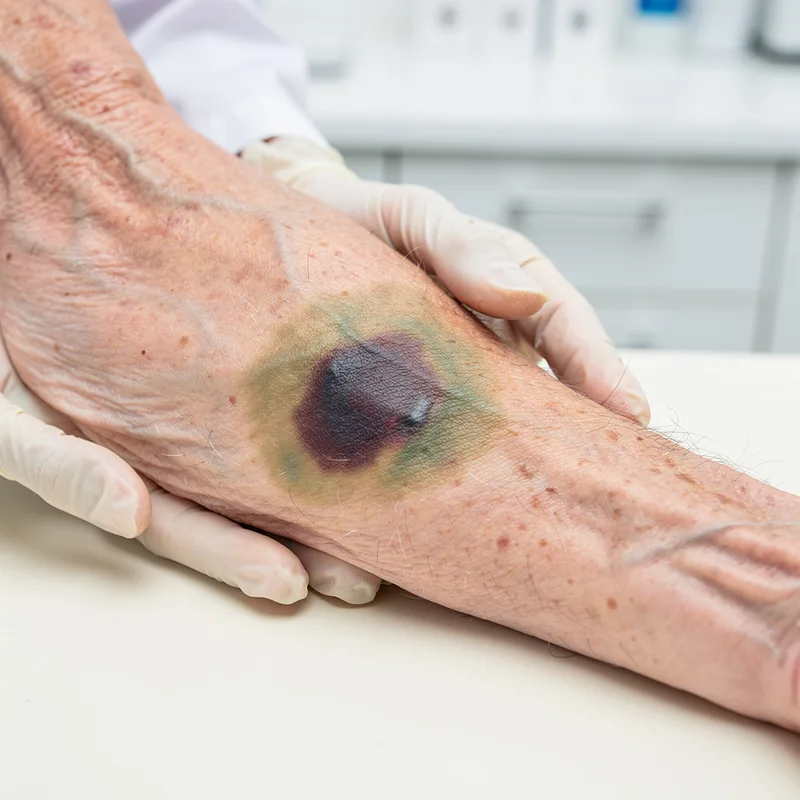
ecchymosis
 3
9.9
3
9.9

- noun
- /ˌɛkɪˈmoʊsɪs/
- Specialized
- Nevertheless, they reported a statistically significant reduction of upper and lower eyelid edema and ecchymosis on postoperative days 1 to 4 compared with placebo.
- periorbital ecchymosis
- swelling and ecchymosis
Examples
-
The clinical triad of hypercalcemia, neck swelling, and ecchymosis has been described.
Academic text (2006) -
After the fall, she noticed ecchymosis developing on her leg, indicating bleeding beneath the skin.
-
Orbital ecchymosis and subcutaneous air developed in three and two other cases, respectively.
Academic text (1999) -
Contusions, abrasions, ecchymosis around the neck.
-
In addition to the pain, the patient also begins to develop ecchymosis, edema, and muscle spasms.
Academic text (2003) -
Ecchymosis around the wound.
-
Edema and ecchymosis are main concerns for patients after rhinoplasty (4).
Academic text (2015) -
Ulceration and ecchymosis were evident over the soft palate, and they extended to the hard palate.
Academic text (2006) -
Postoperative periorbital edema and ecchymosis remain a concern, even for the most experienced surgeons (2).
Academic text (2015) -
In the early postoperative period, periorbital ecchymosis and edema were observed but regressed and faded in eight to ten days.
Academic text (2015)
Synonyms
 64
2.4
64
2.4
Dark purple or yellow marks on the skin after an injury
 56
6.9
56
6.9
An injury that damages the area under unbroken skin and causes a bruise
Antonyms
How Severe

Surface Forms
Etymology
Ecchymosis comes from old Greek parts ec- meaning 'out' and chym- meaning 'juice' or 'fluid'. So an ecchymosis is like a 'flowing out' of blood or fluid under the skin, which is why it appears as a bruise-like mark.