
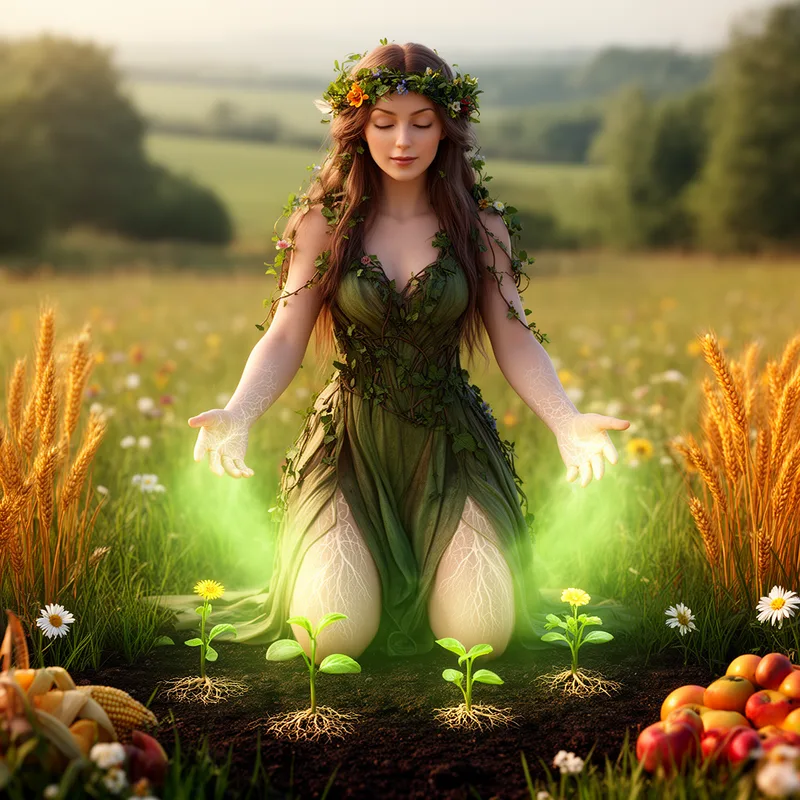
earth goddess


 1
7.6
1
7.6
- noun
- /ɜrθ ˈɡɒdɪs/
- Literature
- The earth goddess is found among the Mongols of the thirteenth century under the name of Etugen/Itugen, probably derived from Otuken, the holy mountain of the Tujue.
Examples
-
The Earth Mother, viewed as Aphrodite or other earth goddesses, was the source of all things.
Academic text (2016) -
As we had disturbed the ground with our excavations, we would hold a ritual sacrifice ceremony at the ruins in honor of Pachamama, the earth goddess.
Academic text (2003) -
In the early Christian era, the cult of Mary gradually replaced the worship of Aphrodite and other earth goddesses, despite papal prohibitions against Mariolatry.
Academic text (2016) -
On Helen as Faust's mother-earth goddess and Goethe's role in forging the new goddess myth, see Norman Austin, "Robert Graves and the Scholars."
Academic text (2016) -
Many ancient cultures revered the earth goddess as the nurturer of all plants and animals.
-
The villagers held a festival each spring to honor the earth goddess and celebrate the fertility of their land.
-
In various mythologies, the earth goddess symbolizes the connection between nature, fertility, and the abundance of life.
Synonyms
 47
9.9
47
9.9
A Greek goddess who is the earth and mother of the Titans
 14
9.9
14
9.9
A Roman goddess of the earth who protects marriage and helps crops grow
 8
8.9
8
8.9
A Greek goddess who is the Earth and mother of the Titans
 5
9.9
5
9.9
A Sumerian goddess who is the earth and brings fertility
 3
9.9
3
9.9
The Greek earth goddess who is mother of Cronus and the Titans
 1
8.5
1
8.5
A female spirit who represents the Earth and gives life and fertility

A female being who people believe looks after the earth, plants, and crops

A Hindu goddess who represents the earth and is one of Vishnu's wives

A figure in modern spiritual beliefs who represents Earth as a caring mother
Surface Forms
Morphology
The meaning 'a goddess associated with the earth' is directly and transparently built from 'earth' (the planet/element) + 'goddess' (female deity); a learner who knows both words can infer the compound meaning. This noun+noun composition and the concept of an earth deity are cross-linguistically common, so the MWE is immediately comprehensible to a B1 learner.
Etymology
The compound earth goddess comes from old stories where the earth itself is a goddess, so people pictured a mother with fields and plants growing from her body. People worshipped her as the source of crops and life, so the term means 'a goddess of the earth, fertility, and plants'.