

dyer's woad
- noun
- /ˈdaɪərz woʊd/
- UK
- Dyer's woad was once widely grown in Europe to produce blue dye for textiles.
Examples
-
The dyer's woad plant is known for its blue dye.
-
Historical records mention that dyer's woad was an important crop before the introduction of indigo.
-
The fields were covered in dyer's woad, ready to be harvested for their valuable leaves.
-
Did you know that dyer's woad was used in ancient textiles?
-
Dyer's woad was once widely grown in Europe to produce blue dye for textiles.
-
Historical records mention that dyer's woad was an important crop before the introduction of indigo.
-
The fields were covered in dyer's woad, ready to be harvested for their valuable leaves.
Synonyms

A European plant that grows for two years and whose leaves make blue dye
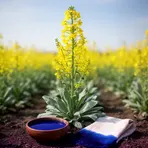
A yellow-flowered plant once grown for a blue dye
Surface Forms
Morphology
dyer's + woad
The phrase combines the possessive/adjectival form 'dyer's' (relating to someone who dyes) with 'woad' (a dye-producing plant), so a learner who knows both constituents can infer it refers to the woad used by dyers — i.e., a plant for dyeing (historically yielding blue). This is a straightforward compositional noun phrase following normal English patterns, so the overall meaning is derivable from its parts.
Etymology
The noun dyer's woad is named for its use: dyer is a person who dyes cloth and woad is a plant whose leaves were soaked and squeezed to make 'blue dye'. So, the name simply means the plant used to make blue dye.

