
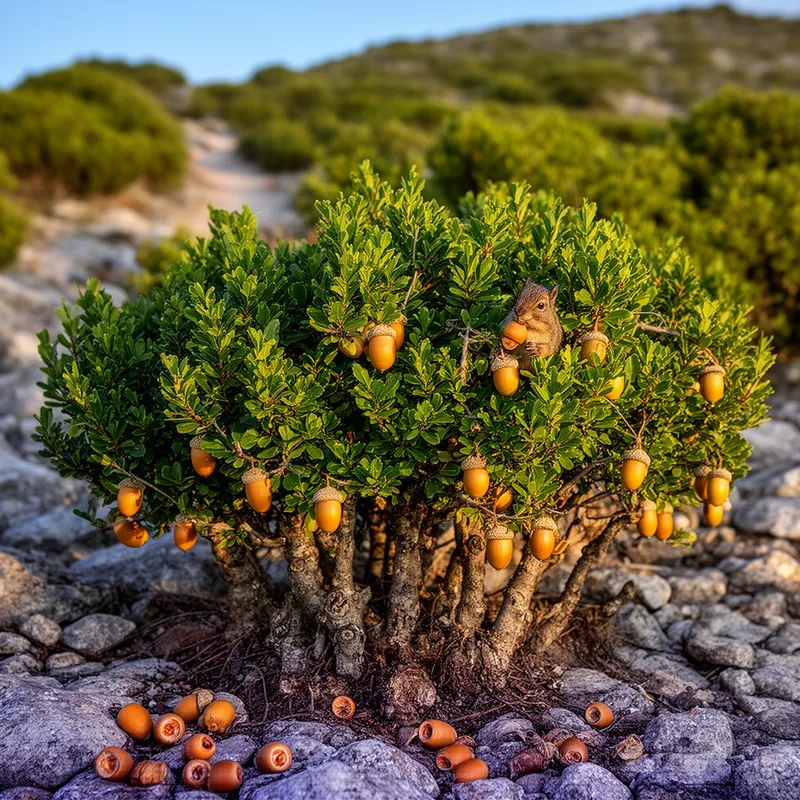
dwarf oak
- noun
- /dwɔrf oʊk/
- US
- In autumn, the leaves of the dwarf oak turn vibrant colors, adding beauty to the landscape.
Examples
-
While hiking in the woods, we discovered a thicket of dwarf oaks that provided excellent shelter from the wind.
-
The distilleries were fueled by wood obtained from local dwarf oak trees, which probably gave the mountains their green appellation, but whose cutting seriously increased deforestation.
Academic text (1992) -
The dwarf oak produces sweet nuts that are popular among local wildlife and can be enjoyed by humans too.
Synonyms
A small bushy oak tree that makes sweet small acorns and forms dense thickets

A small bushy tree that makes sweet edible nuts and often grows in dense groups
A small bushy tree that loses its leaves each year, has sweet nuts, and grows in dense groups
Surface Forms
Morphology
The meaning 'a small shrubby oak' is directly and literally derivable from combining 'dwarf' (unusually small) with 'oak' (a type of tree); the compound transparently denotes a small oak. This kind of descriptive noun compounding is common cross-linguistically and would be understandable to a B1 learner who knows both constituent words.
Etymology
The noun dwarf oak comes from a simple picture: the word dwarf means 'small' and oak is the familiar tree, so it names a short, bush-like oak that grows close to the ground. That's why the name describes a small, shrubby oak that often forms dense thickets and makes edible nuts.

