

dry plate
- noun
- /draɪ pleɪt/
- Archaic
- The inventor of the dry plate changed the way photographs were taken by using a light-sensitive emulsion.
- dry plate process
Examples
-
Photographers in the 19th century often relied on dry plates to capture high-quality images.
-
The first dry plates I saw came over from Liverpool about 1865.
Fiction book (1993) -
This is called a gelatin dry plate and this is what Mr.Eastman made his fortune with.
-
Mr. Eastman, the dry-plate manufacturer in Rochester, revolutionized photography when he found a way to put his emulsion on a paper base.
Fiction book (1993) -
Before film became popular, many photographers used a dry plate to develop their images.
Synonyms
 3
6.8
3
6.8

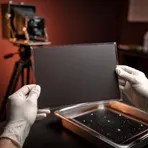
A flat sheet of glass or metal covered with a material that reacts to light to record pictures
Surface Forms
Morphology
The compound is compositionally built from 'dry' + 'plate' (a plate that is dry), so a basic sense of a non-wet plate is transparent; however the specific technical meaning — a glass photographic plate coated with a light-sensitive emulsion — is specialized and not predictable for an average B1 learner who only knows the constituent words. Because the relation is partly derivable but requires domain knowledge to reach the photographic sense, this is best classified as semi-transparent.
Etymology
Dry plate comes from 19th-century photography when a glass plate was coated with a light-sensitive layer that could be left 'dry' and used later, unlike older 'wet' plates that had to be developed right away. That's why dry plate means a glass photographic plate that did not need immediate processing.